Environmental Permit Renewal in Qatar: A Practical Checklist for Existing Facilities
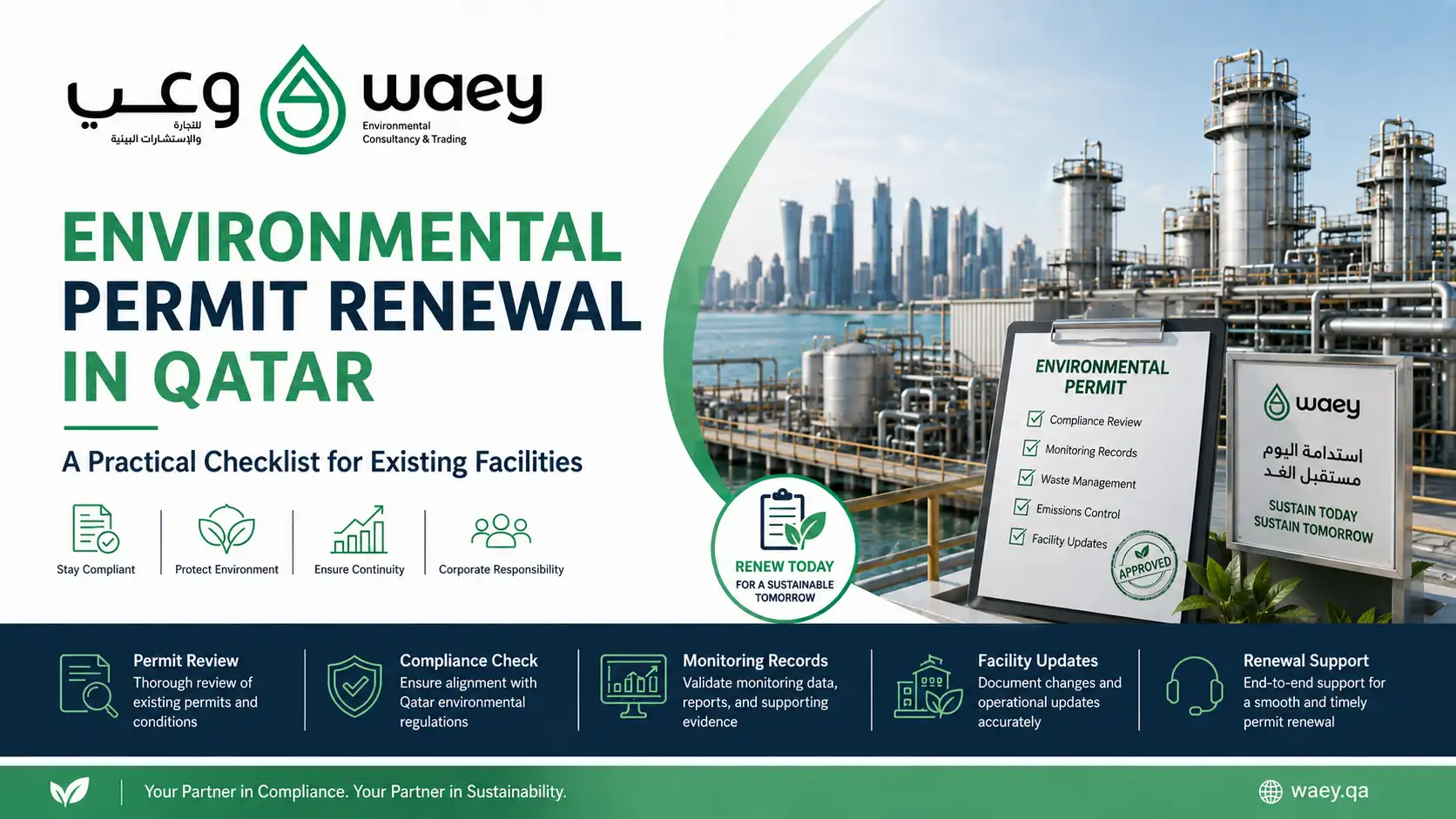
An Environmental Permit Renewal in Qatar should not begin when a permit is already close to expiry.
For an operating facility, environmental approval is connected to what actually happens on site every day. Waste is generated, equipment runs, fuel and chemicals may be stored, wastewater is managed, emissions may need monitoring, and environmental records continue to build up.
When renewal time comes, those operational records can become just as important as the original application.
This is why businesses should treat environmental permit renewal as an ongoing compliance process rather than a last-minute administrative task.
A facility that maintains its documents, monitoring results, environmental management procedures and corrective actions throughout the permit period will normally be in a much stronger position when preparing its next submission.
This guide explains what businesses should review before an environmental permit renewal in Qatar, where common gaps appear, and how Waey Environmental Consultancy & Trading can support existing facilities with permit documentation and environmental compliance.
What Is Environmental Permit Renewal?
Environmental permit renewal is the process of maintaining the required environmental approval for a facility, establishment, project or activity beyond the validity period of its existing permit.
However, renewal should not be viewed as simply obtaining a new date on an old document.
The operating condition of a facility may have changed since the previous permit was issued. Equipment may have been added. Production may have increased. A new waste stream may exist. Storage areas may have moved. New generators may be operating. Drainage arrangements may have changed.
For that reason, the information supporting a renewal should reflect the actual facility.
The official Ministry of Environment and Climate Change service catalogue lists environmental permit renewal services for different types of projects and establishments in Qatar.
Who Oversees Environmental Permits in Qatar?
Environmental permitting falls under Qatar’s Ministry of Environment and Climate Change.
The Ministry’s Environmental Assessment and Permits Department is responsible for studying environmental permit applications for establishments, projects and activities. Its responsibilities also include following permit validity periods, assessing the environmental status of existing facilities, reviewing environmental studies and issuing operating permits after confirming compliance with applicable environmental requirements.
This makes one point clear for facility operators: environmental permit management does not stop after the first approval.
Why Existing Facilities Should Plan Permit Renewal Early
Renewal becomes difficult when environmental information has been left scattered across several departments.
The HSE team may have monitoring reports. Maintenance may hold generator records. Operations may have production information. Administration may hold waste contractor documents. Meanwhile, an older environmental plan may no longer reflect the current site.
Finding and correcting all of this shortly before renewal can create unnecessary pressure.
Starting early gives the facility time to:
- Check the current permit and its conditions
- Review the permit validity period
- Confirm whether site activities have changed
- Organize monitoring and inspection records
- Update environmental plans where necessary
- Resolve outstanding environmental issues
- Collect missing technical information
- Coordinate different departments before submission
If you need broader support with new applications, approvals or regulatory coordination, see Waey’s guide to Environmental Permit Support in Qatar.
Environmental Permit Renewal Starts With the Current Permit
Before preparing anything new, review the permit you already have.
This sounds obvious, but it is one of the easiest steps to overlook.
The permit may contain specific environmental conditions relating to monitoring, emissions, waste, wastewater, reporting, storage, equipment or operational controls.
Create a simple register of every condition and ask:
- What does this condition require?
- Who is responsible for it?
- What evidence do we have?
- Has it been completed?
- Is it ongoing?
- Is there any open corrective action?
This turns the permit into a working compliance checklist instead of a document kept in a folder until renewal time.
Has Anything Changed Since the Previous Permit?
This is one of the most important questions to ask before renewal.
A facility can change considerably over a permit period.
Possible changes include:
- New machinery or production equipment
- Additional generators
- Changes in production capacity
- New raw materials
- Different chemicals or fuels
- New storage tanks
- Changes to wastewater generation
- New discharge points
- Changes in waste quantities
- Additional hazardous waste streams
- Changes to site layout
- Expansion of warehouse or operational areas
- Changes in process emissions
- Different working hours
The renewal documentation should not describe the facility as it existed several years ago if the real operation has changed.
That mismatch can create questions during technical review or inspection.
Practical Environmental Permit Renewal Checklist
The exact documents required will depend on the facility, activity and applicable MECC requirements. However, an internal readiness review should usually cover the following areas.
1. Existing Environmental Permit
Keep a clear copy of the current environmental permit and review the validity period, facility details and permit conditions.
Check whether the company name, site information and described activities still match the current operation.
2. Facility and Activity Information
Prepare an updated description of the facility.
This may include:
- Location
- Site layout
- Operating activities
- Working hours
- Production process
- Main equipment
- Utilities
- Storage areas
- Waste areas
- Drainage arrangements
- Emission sources
A clear facility description makes it easier to understand the environmental risk profile of the operation.
3. Previous Permit Conditions
Prepare a condition-by-condition review of the existing permit.
Do not simply state that the facility has complied. Keep evidence wherever possible.
Evidence may include monitoring results, photographs, inspection forms, contractor records, maintenance records, training records or corrective action closure documents.
4. Environmental Monitoring Records
If the existing permit or environmental plan requires monitoring, make sure the records are complete and easy to trace.
Depending on the facility, monitoring may involve:
- Ambient air quality
- Stack emissions
- Noise
- Wastewater
- Groundwater
- Soil
- Other site-specific environmental parameters
If monitoring requirements apply to your site, Waey’s Environmental Monitoring Services in Qatar guidance explains why structured monitoring is important for environmental management.
5. Waste Management Records
Waste is one of the areas that can reveal how well a facility manages day-to-day environmental responsibilities.
Review:
- Types of waste generated
- Waste quantities
- Segregation arrangements
- Waste storage areas
- Hazardous waste, where applicable
- Collection frequency
- Waste contractor information
- Available transfer or disposal records
The physical condition of the waste storage area should also match what the facility’s procedures say on paper.
6. Chemical and Fuel Management
Facilities that store fuel, oil, chemicals, paints, cleaning products or other controlled materials should review how these materials are managed.
Check areas such as:
- Storage condition
- Labelling
- Secondary containment
- Safety data sheets
- Spill kits
- Inspection records
- Emergency response arrangements
If the facility has added new materials since its previous permit, make sure they are included in the environmental review.
7. Wastewater and Drainage
Wastewater arrangements deserve careful attention.
The facility should understand where different water streams come from, where they go and how they are controlled.
Review:
- Domestic wastewater
- Process wastewater
- Wash water
- Stormwater
- Drainage channels
- Treatment systems, where applicable
- Collection arrangements
- Discharge points
Any change to the drainage or wastewater system since the previous permit should be identified early.
8. Air Emission Sources
Check whether the facility has generators, boilers, stacks, vents, production equipment or other sources that may release emissions.
Compare the current equipment list with the information used during the previous environmental approval.
If new equipment has been installed or operational conditions have changed, the environmental documentation may need to reflect that change.
9. Noise Sources
Compressors, generators, workshops, loading activities, machinery and vehicle movements can all contribute to operational noise.
Review whether the main sources have changed and whether monitoring or additional control measures are required under the existing approval conditions.
10. Environmental Incidents and Corrective Actions
A spill or environmental incident does not automatically mean a facility has poor environmental management.
What matters is how the facility responded.
Keep records showing:
- What happened
- When it happened
- What immediate action was taken
- What caused the incident
- What corrective action was implemented
- Whether the action was closed
Unresolved actions should not be forgotten until renewal time.
Why OEMP Matters During Permit Renewal
An environmental permit tells a facility what it must comply with. An operational environmental management plan helps the facility put those requirements into practice.
This is why permit renewal and OEMP review often belong in the same conversation.
A strong Operation Environmental Management Plan in Qatar can organize:
- Permit conditions
- Monitoring responsibilities
- Waste controls
- Wastewater procedures
- Air and noise controls
- Emergency response
- Inspection schedules
- Reporting
- Corrective actions
If the OEMP was prepared several years ago, review it before renewal. It should describe the facility as it operates today.
Environmental Compliance Monitoring Before Renewal
One of the most useful things a facility can do before renewal is conduct its own compliance review.
Do not wait for an external inspection to identify obvious gaps.
A pre-renewal environmental inspection can check:
- Permit-condition compliance
- Waste storage
- Chemical storage
- Drainage condition
- Spill preparedness
- Monitoring records
- Housekeeping
- Equipment changes
- Environmental complaints
- Open corrective actions
Waey’s guide to Environmental Compliance Monitoring in Qatar explains how inspections, evidence and follow-up actions work together to keep facilities ready for environmental review.
Do You Need a New EIA When Renewing a Permit?
Not every permit renewal should automatically be treated as a new Environmental Impact Assessment project.
The correct approach depends on the nature of the facility, the existing approval, changes in operations and what the authority requires for the particular case.
However, a significant change to a project or operational activity may require further environmental assessment or supporting technical information.
This is another reason to identify operational changes before starting the renewal process.
If you need to understand the wider assessment process, read Waey’s guide to Environmental Impact Assessment in Qatar.
Common Problems That Can Complicate Permit Renewal
Most renewal problems do not appear overnight. They build slowly when routine environmental management is weak.
Common issues include:
- Waiting until the permit is close to expiry
- Using an outdated facility description
- Missing monitoring reports
- Incomplete waste records
- Permit conditions that were never assigned to responsible staff
- Environmental plans that do not match the current operation
- New equipment that has not been reflected in environmental documentation
- Changes to chemical or fuel storage
- Open corrective actions
- Weak incident records
- Poor coordination between HSE, operations and maintenance teams
- Different information appearing in different documents
A short readiness review can identify many of these gaps before the renewal submission is prepared.
What Is a Permit Renewal Readiness Review?
A permit renewal readiness review is an internal assessment carried out before the formal renewal process begins.
The purpose is simple: find the gaps while there is still time to correct them.
A useful review compares four things:
- The current environmental permit
- The actual condition of the facility
- The environmental records maintained during operation
- The documents that will support the renewal
If these four areas tell the same story, the facility is usually much easier to document.
If they do not, the differences should be understood and corrected before submission wherever appropriate.
How Far in Advance Should a Facility Prepare?
There is no sensible reason to wait for the final days of permit validity before checking environmental records.
Instead, facilities should manage permit conditions throughout the operating period and begin their renewal readiness review early enough to deal with missing information or technical work.
The amount of preparation time needed will vary.
A small facility with stable operations and well-maintained records may need less preparation than a complex industrial site with multiple emission sources, monitoring programmes and recent operational changes.
The important point is to work backwards from the permit validity date and leave enough time for internal review, technical work and any required corrections.
Environmental Permit Renewal Is Not Only an HSE Responsibility
Environmental permits often sit with the HSE team, but HSE cannot maintain every piece of supporting evidence alone.
Different departments may need to contribute.
Operations
Operations should confirm current activities, production information, operating schedules and process changes.
Maintenance
Maintenance may hold records for generators, equipment servicing, pollution-control systems, leaks and repairs.
Procurement
Procurement may have information about waste contractors, chemical suppliers and environmental service providers.
Facility Management
Facility teams can provide information on drainage, utilities, waste areas and site changes.
Management
Management should ensure that responsibilities, corrective actions and budgets are addressed before they create compliance problems.
Good environmental permit management is therefore a company responsibility, even when one person coordinates the process.
Use an Environmental Compliance Calendar
One practical improvement is to create a simple environmental compliance calendar.
It can include:
- Permit expiry date
- Monitoring dates
- Inspection dates
- Waste-document reviews
- Training dates
- Environmental plan review dates
- Corrective action deadlines
- Internal compliance reviews
This reduces dependence on memory and makes environmental responsibilities easier to track.
The calendar can also form part of the facility’s wider Environmental Management Plan.
Keep an Environmental Evidence Folder
A good permit file should not contain only the permit itself.
Create a structured environmental evidence folder for each operating period.
Depending on the facility, it can include:
- Current environmental permit
- Previous approval correspondence
- Monitoring reports
- Environmental inspection records
- Waste documents
- Incident reports
- Corrective action records
- Training records
- Updated layouts
- Equipment lists
- Environmental management plans
- Relevant photographs
Good document control saves time during renewal and also improves readiness for inspections.
Environmental Permit Renewal and Qatar’s Environmental Framework
Permit renewal sits within Qatar’s wider environmental regulatory framework.
The Ministry publishes Qatar’s environmental laws and regulations through its official Environmental Laws and Regulations section, including Law No. 30 of 2002 concerning environmental protection.
For businesses, the practical lesson is straightforward: approvals, operational controls and environmental records should be managed together.
A permit should never be treated as an isolated certificate.
How Waey Supports Environmental Permit Renewal in Qatar
Waey Environmental Consultancy & Trading supports project owners, companies and existing facilities with environmental permit and compliance-related work in Qatar.
Depending on the facility and applicable requirements, support may include:
- Existing environmental permit review
- Permit-condition checklist preparation
- Environmental permit renewal readiness review
- Facility activity and document review
- Environmental compliance gap identification
- Site environmental inspection support
- Environmental monitoring coordination
- Environmental management plan review
- OEMP preparation or update
- Supporting technical documentation
- Renewal submission coordination
- Response support for technical comments
- Corrective action follow-up
The aim is to make the renewal process easier to manage by improving the quality and consistency of environmental information before submission.
When Should You Contact an Environmental Consultant?
Consider seeking support early if:
- Your permit is approaching its renewal period
- The facility has changed since the last approval
- You cannot locate important monitoring records
- The current OEMP is outdated
- New equipment has been installed
- Waste or wastewater arrangements have changed
- There are unresolved environmental findings
- You are unsure which documents need updating
- The facility has not undergone a recent environmental compliance review
Early review gives the team more time to solve problems properly rather than trying to explain them at the last minute.
Final Thoughts
Environmental Permit Renewal in Qatar is easier when environmental compliance is managed throughout the life of the permit.
The strongest preparation starts with the existing permit, checks the real condition of the facility, reviews operational changes, organizes environmental records and closes compliance gaps before the renewal process becomes urgent.
For existing facilities, this approach does more than support renewal. It improves day-to-day environmental management, strengthens inspection readiness and gives management a clearer picture of environmental responsibilities.
If your facility has an environmental permit that requires renewal, or if you are unsure whether your current environmental records are ready for review, Waey can help assess the position and organize the next steps.
Request environmental permit support from Waey or contact Waey Environmental Consultancy & Trading for project-specific assistance in Qatar.
Frequently Asked Questions
What is environmental permit renewal in Qatar?
Environmental permit renewal is the process of maintaining the required environmental approval for an existing establishment, facility, project or activity beyond the validity period of its current permit, subject to the applicable requirements and review process.
Who manages environmental permits in Qatar?
The Ministry of Environment and Climate Change manages environmental permitting through its relevant departments, including the Environmental Assessment and Permits Department.
When should I start preparing for environmental permit renewal?
Preparation should begin before the permit is close to expiry. Facilities should monitor permit conditions throughout the operating period and allow enough time to review records, operational changes and any outstanding compliance actions.
What should I check before renewing an environmental permit?
Start with the existing permit, its conditions, facility activities, monitoring records, waste documentation, environmental management plans, operational changes, incidents and corrective actions. The exact submission requirements should then be confirmed for the relevant facility and permit type.
Do operational changes matter during permit renewal?
Yes. Changes to processes, equipment, production, chemicals, fuels, waste streams, wastewater, emissions or site layout can affect the environmental profile of a facility and should be reviewed before renewal.
Does an OEMP help with environmental permit renewal?
Yes. A current Operation Environmental Management Plan can help organize permit conditions, monitoring requirements, waste controls, responsibilities, inspection schedules and environmental records for an operating facility.
Does every permit renewal require a new EIA?
Not necessarily. The need for additional environmental assessment depends on the project, existing approval, operational changes and the requirements applicable to the specific case.
Can Waey support environmental permit renewal for existing facilities?
Yes. Waey can support facilities with permit review, compliance gap assessments, environmental documentation, monitoring coordination, OEMP review, supporting technical information and renewal-related environmental consultancy.