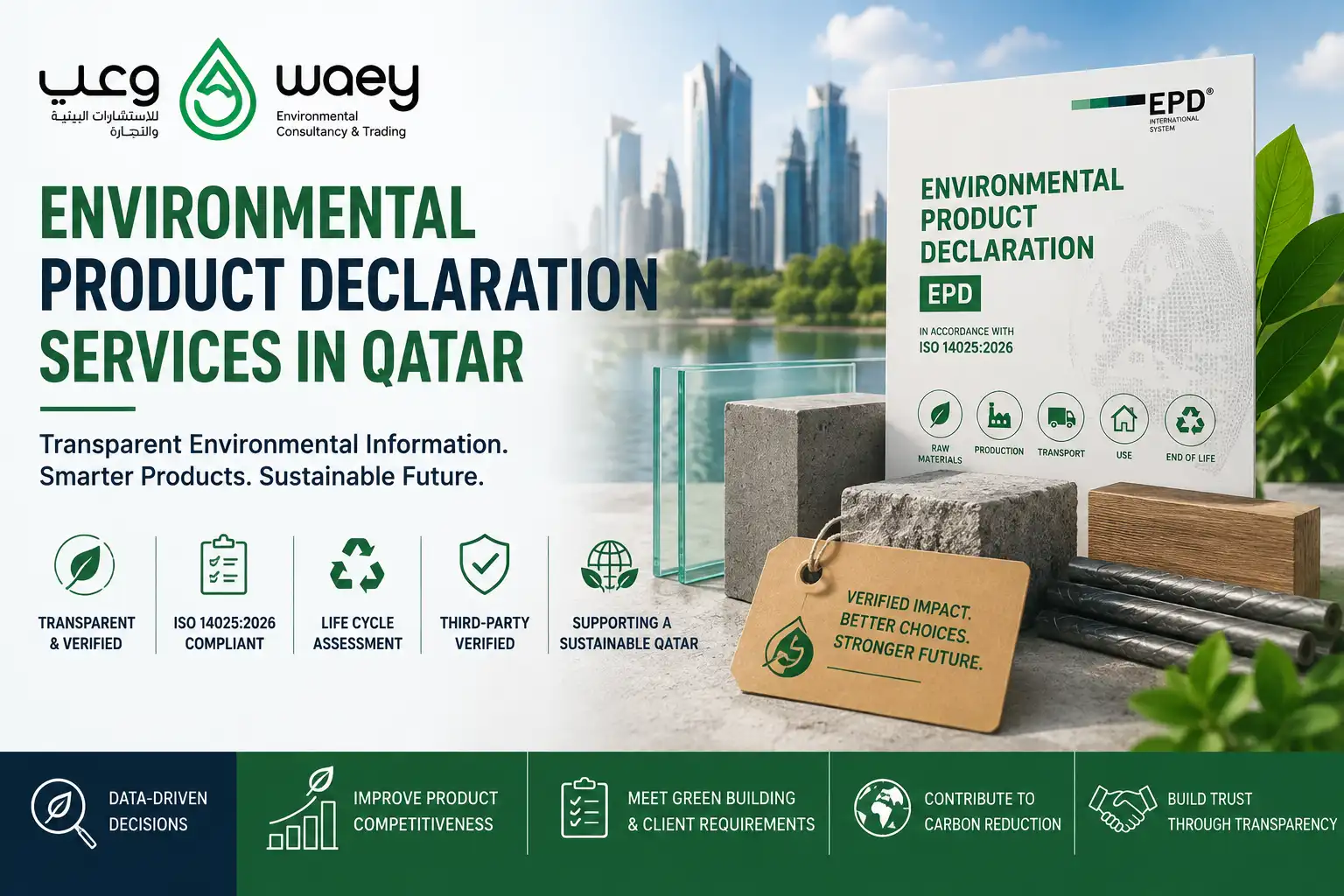
Home / Blog / Environmental Product Declaration Services in Qatar: A Practical Guide for Manufacturers and Suppliers
Environmental Product Declaration Services in Qatar: A Practical Guide for Manufacturers and Suppliers
Environmental Product Declaration Services in Qatar help manufacturers turn complex environmental data into a structured and independently verified declaration based on Life Cycle Assessment.
For businesses that manufacture construction materials, industrial products, components, finishes, packaging, or other products, an EPD can provide a transparent way to communicate environmental performance.
Waey Environmental Consultancy & Trading supports businesses in Qatar with Life Cycle Assessment, Environmental Product Declaration preparation, carbon accounting, sustainability planning, and related environmental consultancy services.
What Is an Environmental Product Declaration?
An Environmental Product Declaration is a structured document that communicates information about the environmental impacts associated with a product or service.
The information is developed using Life Cycle Assessment data and applicable Product Category Rules. The declaration then goes through independent verification before publication under the selected EPD programme.
An EPD should therefore be understood as an environmental transparency document rather than a simple marketing label.
It provides measurable information that can help specifiers, designers, procurement teams, project owners, and other stakeholders understand the environmental profile of a product.
The International EPD System explains that EPDs provide objective, comparable, and third-party-verified information about the environmental performance of products and services.
Why Environmental Product Declarations Matter in Qatar
Qatar has a significant construction, infrastructure, industrial, manufacturing, and real estate market. Products entering these sectors are increasingly assessed not only for price, quality, and technical performance but also for environmental information.
This creates an important opportunity for manufacturers.
A company that already understands the environmental impact of its products is better prepared when a consultant, developer, contractor, sustainability team, or international buyer requests environmental documentation.
EPDs can be particularly relevant to businesses supplying products such as:
- Cement and concrete products
- Steel and metal products
- Insulation materials
- Glass and façade products
- Tiles and flooring
- Precast products
- Blocks and masonry products
- Paints and coatings
- Pipes and infrastructure materials
- Aluminium products
- Interior finishing materials
- Mechanical and building components
- Packaging and manufactured products
The requirement will always depend on the client, project, specification, sustainability framework, product category, and intended market. Therefore, manufacturers should confirm the exact project requirement before beginning an EPD programme.
EPDs and GSAS Projects in Qatar
One reason EPDs deserve attention in Qatar is their connection with sustainable building material assessment.
Documentation published under Qatar’s Global Sustainability Assessment System, or GSAS, identifies materials with Environmental Product Declarations within its environmental material assessment guidance.
Manufacturers supplying projects that follow GSAS requirements may therefore benefit from understanding whether an EPD is relevant to their product and the specific project specification.
Businesses can refer to the official GSAS resources for current programme requirements and project-specific guidance.
However, an EPD should never be prepared simply because a manufacturer assumes every Qatar project requires one. The correct approach is to check the applicable project specification, product category, client requirements, and sustainability framework first.
EPD vs LCA: What Is the Difference?
EPD and LCA are closely connected, but they are not the same thing.
A Life Cycle Assessment in Qatar is the technical study used to assess environmental impacts across defined stages of a product’s life cycle.
The LCA examines inputs and outputs such as raw materials, electricity, fuels, transport, emissions, waste, water consumption, and other relevant environmental data.
An EPD takes the results of the LCA and communicates them through a standardized declaration according to the applicable programme rules and Product Category Rules.
In simple terms:
- LCA calculates and evaluates environmental impacts.
- EPD communicates verified environmental results in a structured format.
A manufacturer planning an EPD therefore needs reliable LCA data first.
What Is ISO 14025?
ISO 14025 is one of the key international standards associated with Environmental Product Declarations.
The current ISO 14025:2026 provides principles, requirements, and guidance for EPD programmes and their associated Environmental Product Declarations.
It also connects EPD development with the Life Cycle Assessment principles established through ISO 14040 and ISO 14044.
For manufacturers preparing a new EPD, using current standards, current programme instructions, and a valid PCR is important. Relying on an old template without checking the latest programme requirements can create problems later during verification.
What Are Product Category Rules?
Product Category Rules, normally shortened to PCR, provide specific instructions for conducting the LCA and preparing an EPD for a particular category of product.
Different products have different manufacturing processes, use patterns, environmental impacts, functional units, and lifecycle boundaries. A common set of rules is therefore needed so that declarations within the same category are prepared consistently.
According to the International EPD System’s PCR guidance, PCR development follows defined procedures and relevant ISO requirements.
Choosing the correct PCR is one of the first decisions in the EPD process.
How Is an Environmental Product Declaration Prepared?
The exact process depends on the programme operator and product category, but a typical EPD project includes the following stages.
1. Define the Product
The first step is to clearly identify the product or product family that will be covered.
The manufacturer should establish:
- Product description
- Manufacturing location
- Production process
- Major raw materials
- Product specifications
- Annual production volume
- Intended market
- Whether one or multiple products will be included
Clear product definition prevents confusion once data collection begins.
2. Select the Appropriate PCR
The next step is to identify the relevant Product Category Rules.
The PCR determines important elements such as the functional or declared unit, lifecycle modules, data requirements, calculation rules, environmental indicators, and reporting structure.
The PCR should be valid for the programme under which the EPD will eventually be published.
3. Set the LCA Goal and Scope
Before calculations begin, the LCA scope must be established.
This includes the product system, boundaries, data period, manufacturing locations, assumptions, allocation approach, and lifecycle stages included in the study.
Good decisions at this stage can prevent major corrections later.
4. Collect Manufacturing Data
Data collection is usually one of the most demanding parts of the project.
The manufacturer may need to provide information about:
- Raw material quantities
- Supplier information
- Electricity consumption
- Fuel consumption
- Water use
- Production volume
- Packaging
- Waste generation
- Waste treatment
- Transport distances
- Process emissions
- Recycled material content
- By-products
The quality of the final LCA depends heavily on the quality of this information.
For that reason, manufacturers should avoid waiting until the last minute to collect records.
5. Conduct the Life Cycle Assessment
Once the data is ready, the Life Cycle Assessment can be developed according to the selected PCR and applicable standards.
The study assesses the environmental impacts associated with the defined product system.
Depending on the product category, results can cover indicators related to climate change, resource use, energy, water, waste, and other environmental impact categories required by the applicable methodology.
6. Identify Environmental Hotspots
The LCA can do more than produce numbers for an EPD.
It can also help the manufacturer understand which parts of the product lifecycle have the greatest environmental impact.
For example, the main impact may come from:
- A particular raw material
- High electricity consumption
- Fuel use
- Long-distance transportation
- Packaging
- Production waste
- A carbon-intensive manufacturing process
This information can support future improvements in product design and manufacturing.
7. Prepare the EPD Document
The LCA results are then organized into the EPD format required by the selected programme.
The document normally includes product information, manufacturer information, technical details, methodology, system boundaries, environmental performance results, assumptions, and other mandatory programme information.
8. Independent Verification
An important part of an EPD is independent verification.
The verifier reviews whether the EPD and supporting LCA documentation meet the relevant PCR, programme rules, and applicable requirements.
This is one reason data traceability is important.
If figures cannot be traced back to reliable records, verification can become more difficult and may require additional clarification or corrections.
9. Register and Publish the EPD
After successful verification, the declaration can proceed through registration and publication with the selected programme operator.
The International EPD System summarizes its process as selecting a PCR, conducting the LCA, compiling information, completing verification, and publishing the EPD.
Manufacturers can review the official EPD development process for further information.
What Data Should a Manufacturer Prepare Before Starting?
One of the best ways to reduce delays is to prepare the right data early.
A preliminary EPD data pack may include:
- Product technical data sheet
- Bill of materials
- Raw material quantities
- Supplier locations
- Monthly or annual electricity records
- Fuel records
- Water consumption
- Production quantities
- Waste quantities
- Waste disposal routes
- Packaging information
- Transport information
- Manufacturing process flow
- Existing environmental reports
Not every document will be required for every product. However, preparing these records early gives the LCA consultant a much stronger starting point.
What Usually Delays an EPD Project?
Technical calculations are only one part of the work. In practice, weak data collection can create more delays than the modelling itself.
Common problems include:
- Missing electricity or fuel records
- No reliable production quantity for the study period
- Incomplete raw material information
- Different product names used across departments
- Supplier locations not available
- Waste quantities not measured
- Incorrect PCR selected at the beginning
- Product scope changing during the project
- Data from different years being mixed without explanation
- Assumptions not being documented clearly
A short data-readiness review before the main LCA starts can prevent many of these problems.
How Long Does an EPD Take?
There is no single timeline that applies to every EPD.
The duration depends on several factors:
- Product complexity
- Number of manufacturing locations
- Number of products covered
- Availability of primary data
- PCR availability
- LCA modelling requirements
- Number of revisions
- Verifier availability
- Programme operator review
A manufacturer with well-organized data will generally move through the process more efficiently than a company that begins collecting records only after the project starts.
What Determines the Cost of an EPD?
EPD cost also varies from product to product.
Important factors include:
- Complexity of the manufacturing process
- Number of products
- Number of manufacturing plants
- Availability and quality of existing data
- Whether a suitable PCR already exists
- Scope of the LCA
- Verification requirements
- Programme registration and publication requirements
Rather than choosing an EPD consultant based only on the lowest initial price, manufacturers should confirm what the proposal actually includes.
The scope should make clear whether it covers data review, LCA modelling, EPD preparation, support during verification, revisions, and assistance with publication.
Can One EPD Cover Multiple Products?
In some situations, an EPD can cover more than one product, but this depends on programme rules, PCR requirements, product similarity, manufacturing conditions, and how the products are marketed.
Manufacturers with several similar products should discuss this during the initial scope review rather than automatically preparing separate studies for every item.
A suitable grouping approach may reduce duplicated work while still meeting programme requirements.
Can EPD Data Support Carbon Reduction?
Yes. Although an EPD has a different purpose from corporate carbon accounting, the underlying LCA can reveal where significant environmental impacts occur within the product lifecycle.
For example, a company may discover that one raw material contributes heavily to product-related greenhouse gas emissions or that manufacturing electricity is a major hotspot.
That information can support future actions such as material substitution, energy efficiency, recycled content review, process improvement, or supplier engagement.
At the organizational level, companies can complement product-level assessment with GHG Accounting and Verification in Qatar to understand emissions across their wider business operations.
How EPD Supports a Sustainability Roadmap
For manufacturers, an EPD can become part of a broader sustainability improvement programme.
The lifecycle study may identify areas where the company can improve:
- Material efficiency
- Energy consumption
- Waste generation
- Packaging
- Transportation
- Recycled content
- Supplier selection
- Product design
These findings can then be incorporated into a Sustainability Roadmap in Qatar with measurable actions and responsibilities.
EPD and ESG Reporting
Product environmental data can also support wider sustainability and ESG discussions within a company.
Manufacturers increasingly need better-quality information about materials, emissions, resource use, waste, and supply chains.
An EPD does not replace corporate ESG reporting. However, the structured environmental information behind an EPD can contribute useful product-level evidence to a company’s wider sustainability data system.
Businesses building their ESG programme can review Waey’s Environmental, Social and Governance services in Qatar.
Common Mistakes Manufacturers Should Avoid
Preparing an EPD becomes much easier when the project starts with the right expectations.
Some common mistakes include:
- Treating an EPD as a simple certificate
- Starting before confirming the correct PCR
- Using estimated manufacturing data when primary records are available
- Mixing data from different products without a clear methodology
- Ignoring transport information
- Not documenting assumptions
- Changing product scope halfway through the study
- Assuming an EPD automatically means a product has a lower environmental impact than another product
- Preparing an EPD without first confirming the client’s or project’s actual requirement
- Using an outdated template without checking current programme rules
A well-planned EPD project starts with scope, PCR, data readiness, and publication requirements clearly understood.
When Should a Manufacturer Start the EPD Process?
The best time is usually before the EPD becomes an urgent tender requirement.
If a manufacturer waits until a contractor asks for an EPD during a live submission, there may not be enough time to collect data, complete the LCA, resolve technical questions, arrange independent verification, and finish publication.
Companies that regularly supply major projects can benefit from assessing EPD readiness in advance.
A preliminary review can answer:
- Does a suitable PCR exist?
- Is manufacturing data available?
- Which product should be prioritized?
- Can multiple products be grouped?
- What information is currently missing?
- Which programme is suitable for the intended market?
How Waey Supports Environmental Product Declaration Services in Qatar
Waey supports manufacturers and businesses that need structured environmental and sustainability documentation in Qatar.
Depending on the project requirements, Waey can assist with:
- Initial EPD feasibility and scope review
- Product and manufacturing process review
- PCR identification support
- Data requirement checklist preparation
- Manufacturing data collection guidance
- Life Cycle Assessment
- Environmental impact modelling
- EPD document preparation
- Coordination support during independent verification
- Revision and technical clarification support
- EPD registration and publication support
- Product carbon and sustainability improvement planning
Waey’s Life Cycle Assessment services provide the technical foundation required to understand product lifecycle impacts and prepare environmental declarations.
Companies can also use Waey’s Get a Quote page and select Environmental Product Declaration (EPD) when requesting support.
Why Start With an EPD Readiness Review?
Not every manufacturer is ready to begin the full EPD process immediately.
Sometimes the better first step is a readiness review.
This can identify missing production data, unclear product boundaries, incomplete supplier information, unsuitable data periods, or PCR questions before significant modelling work begins.
For manufacturers new to LCA and EPD preparation, this approach can make the full project easier to manage.
Final Thoughts
Environmental Product Declaration Services in Qatar are becoming increasingly relevant for manufacturers that want reliable, structured, and transparent environmental information for their products.
An effective EPD project starts long before the final declaration is published. It starts with choosing the correct product scope, finding the applicable PCR, collecting reliable manufacturing data, conducting the Life Cycle Assessment, preparing the declaration, and completing independent verification.
The greatest value is not simply having another document.
The real value comes from understanding what the environmental data says about the product and using that information to make better decisions.
If your company manufactures or supplies products in Qatar and has been asked for an EPD, LCA, lifecycle data, or environmental product information, Waey Environmental Consultancy & Trading can help you understand the required process before you begin.
For project support, contact Waey or email info@waey.qa.
Frequently Asked Questions
What is an Environmental Product Declaration?
An Environmental Product Declaration is a structured environmental statement based on Life Cycle Assessment data. It communicates measurable information about the environmental performance of a product and normally undergoes independent verification according to the applicable EPD programme requirements.
Is an EPD the same as an LCA?
No. Life Cycle Assessment is the technical study used to calculate environmental impacts. An EPD uses LCA results and communicates them through a standardized declaration based on applicable Product Category Rules and programme requirements.
Who needs Environmental Product Declaration services in Qatar?
Manufacturers and suppliers may need an EPD when it is requested by a project specification, client, consultant, developer, sustainability framework, procurement process, or export customer. Construction-material manufacturers are among the businesses most likely to receive such requests.
What information is required for an EPD?
Typical information includes raw material quantities, energy use, fuel use, water consumption, production volume, packaging, transport, waste, manufacturing process information, and other product-specific environmental data required by the applicable PCR.
Does an EPD need third-party verification?
EPDs published through established EPD programmes undergo independent verification according to the rules of the programme and applicable standards.
What are Product Category Rules?
Product Category Rules provide specific instructions for conducting the LCA and preparing an EPD for a particular product category. They help ensure that products within the same category are assessed using consistent rules.
Can one EPD cover several products?
It may be possible depending on product similarity, manufacturing conditions, the selected PCR, and programme requirements. This should be reviewed before defining the final project scope.
Can Waey support EPD preparation in Qatar?
Yes. Waey supports manufacturers with Life Cycle Assessment, EPD preparation, product data review, PCR identification, environmental modelling, verification coordination, and related environmental and sustainability consultancy services.