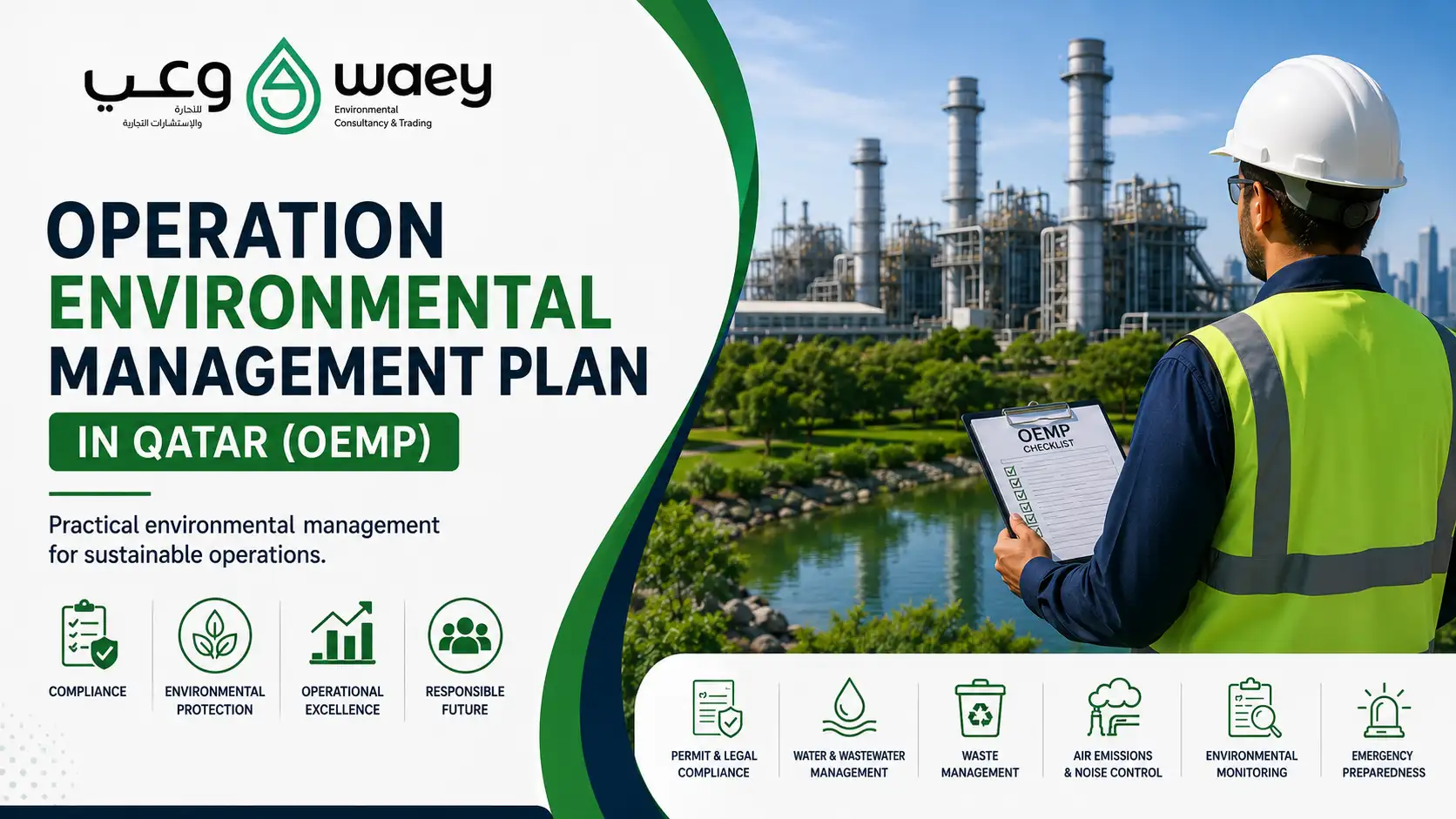
Home / Blog / Operation Environmental Management Plan in Qatar: Why Every Facility Needs a Practical OEMP
What Is an Operation Environmental Management Plan?
An Operation Environmental Management Plan is a site-specific plan that explains how environmental impacts will be managed once a project or facility is in operation.
It usually covers environmental risks, control measures, monitoring requirements, waste handling, wastewater management, air emissions, noise control, spill response, inspection schedules, reporting, training, and recordkeeping.
In simple terms, an OEMP turns environmental commitments into practical daily procedures.
A strong OEMP should not be generic. It should reflect the real facility, the real activities, the real permit conditions, and the real environmental risks. This is why many businesses prefer to work with an experienced environmental consultant in Qatar before preparing or updating the plan.
Why OEMP Is Important for Facilities in Qatar
Qatar continues to develop across infrastructure, energy, logistics, commercial, industrial, and public service sectors. With this growth, project owners and facility operators are expected to manage environmental impacts in a more structured and responsible way.
An OEMP helps businesses move from basic environmental awareness to proper operational control.
It gives the site team clear answers to practical questions such as:
- What environmental risks exist at the facility?
- Which environmental permit conditions must be followed?
- What should be monitored?
- How often should inspections be carried out?
- Who is responsible for waste records?
- What should happen if there is a spill, leak, or abnormal discharge?
- How should environmental complaints be handled?
- Which records should be kept ready for review?
Without an OEMP, these responsibilities can become scattered across different teams. This can lead to missed inspections, weak records, poor communication, delayed corrective action, and avoidable non-compliance.
A properly prepared OEMP helps keep everything organized and easier to manage.
CEMP and OEMP: What Is the Difference?
Many project teams are familiar with a CEMP, but not everyone clearly understands how it differs from an OEMP.
A Construction Environmental Management Plan in Qatar is used during the construction stage. It focuses on temporary construction-related impacts such as dust, construction waste, excavation, heavy equipment movement, noise, site runoff, fuel storage, and contractor activities.
An OEMP is used during the operational stage. It focuses on long-term environmental management after the facility starts functioning.
For example, a CEMP may control dust from excavation, while an OEMP may control emissions from operational equipment. A CEMP may manage construction waste, while an OEMP manages daily waste streams generated by the facility. A CEMP may cover temporary drainage, while an OEMP covers routine wastewater, stormwater, and maintenance-related risks.
Both plans are important, but they are not the same document.
A common mistake is to take an old CEMP, change the title, and call it an OEMP. This does not work well because operational environmental risks are different from construction-stage risks.
When Does a Facility Need an OEMP?
An OEMP may be needed when a new facility is moving toward operation, when an existing facility is updating its environmental controls, or when environmental approval conditions require a clear operational plan.
It can also be useful when a business has expanded over time and the old environmental documents no longer match the actual site activities.
An OEMP is especially useful for:
- Industrial facilities
- Warehouses and logistics yards
- Infrastructure projects
- Commercial and mixed-use developments
- Workshops and maintenance facilities
- Water and wastewater-related facilities
- Sites with generators, fuel tanks, chemical storage, or waste storage areas
- Facilities with regular environmental monitoring obligations
- Projects connected with public infrastructure or Ashghal-related requirements
For project teams working under infrastructure expectations, it is useful to understand the role of an Ashghal PWA Approved Environmental Consultancy in Qatar when preparing environmental documentation and compliance records.
What Should an OEMP Include?
A good OEMP should be practical, clear, and easy to follow. It should help the facility team understand what must be done, when it must be done, and who is responsible.
Below are the main sections that should normally be included in an Operation Environmental Management Plan.
1. Facility Description
The OEMP should begin with a clear description of the facility.
This may include the location, site layout, main activities, operating hours, storage areas, drainage routes, waste areas, access points, nearby receptors, equipment, utilities, and operational process flow.
This section is important because the rest of the OEMP should be based on the actual site condition. If the site description is weak, the controls may also become weak.
2. Environmental Permit and Approval Conditions
The OEMP should identify applicable environmental approvals, permit conditions, monitoring requirements, reporting obligations, and renewal dates.
This section helps the management team understand what the facility is required to follow. It also helps during inspections, audits, and internal reviews.
Businesses that are unsure about approval requirements can benefit from professional Environmental Permit Support in Qatar, especially when documentation needs to be aligned before submission or operation.
3. Environmental Aspects and Risks
Every facility has environmental aspects. These are the activities or conditions that may interact with the environment.
Examples include:
- Waste generation
- Wastewater discharge
- Fuel storage
- Chemical handling
- Air emissions
- Noise from equipment
- Vehicle movement
- Water consumption
- Energy consumption
- Stormwater runoff
- Emergency spills or leaks
The OEMP should identify these aspects, assess their possible impacts, and provide clear control measures.
This section should be written based on real operations, not assumptions.
4. Air Emissions and Dust Control
If the facility has generators, stacks, boilers, vents, process equipment, vehicle movement, loading areas, or dust-producing activities, the OEMP should explain how air emissions and dust will be controlled.
This may include preventive maintenance, fuel quality control, stack monitoring, dust suppression, housekeeping, inspection schedules, and records.
Where regular air quality checks are needed, the OEMP can be connected with Environmental Monitoring Services in Qatar to support better compliance and recordkeeping.
5. Waste Management
Waste management is one of the most important parts of an operational environmental plan.
The OEMP should clearly explain the waste types generated by the facility, how they are segregated, where they are stored, how often they are collected, who collects them, and what records are maintained.
This may include:
- General waste
- Recyclable waste
- Packaging waste
- Used oil
- Chemical containers
- Contaminated materials
- Filters
- Sludge
- Maintenance waste
- Hazardous waste, where applicable
The plan should also include labelling, storage conditions, housekeeping, disposal documentation, and contractor control.
Good waste control protects the site from environmental risk and also helps the facility maintain clean evidence during inspections.
6. Wastewater and Drainage Management
Wastewater and drainage controls should be clearly addressed in the OEMP.
The plan should explain how wastewater, wash water, process water, stormwater, and drainage channels are managed. It should also identify discharge points, treatment systems, inspection points, maintenance schedules, and emergency controls.
For many facilities, drainage is one of the easiest areas to overlook. If chemicals, oil, sediment, or waste enter the wrong drain, the site may face serious environmental issues.
A practical OEMP should make it clear what can enter each drainage route and what must never be discharged.
7. Chemical and Fuel Storage
If the facility stores chemicals, fuel, oils, paints, cleaning agents, or other controlled materials, the OEMP should include specific storage and handling procedures.
This may include:
- Secondary containment
- Safety data sheets
- Material labelling
- Compatibility checks
- Restricted access
- Spill kits
- Inspection checklists
- Emergency contacts
- Staff training
- Incident reporting
The goal is to prevent leaks, spills, unsafe handling, and accidental environmental release.
8. Noise and Nuisance Control
Operational noise can come from generators, pumps, compressors, loading areas, vehicles, workshops, or plant equipment.
The OEMP should identify potential noise sources and explain how noise will be managed. This may include equipment maintenance, operating hour controls, noise barriers, staff awareness, complaint response, and monitoring where required.
If the facility is near residential, commercial, community, healthcare, or education areas, this section becomes more important.
9. Emergency Preparedness and Spill Response
Even a well-managed facility can face unexpected incidents.
The OEMP should explain what the site team must do during spills, leaks, abnormal emissions, wastewater issues, waste mishandling, firewater runoff, or environmental complaints.
This section should include:
- Immediate response steps
- Internal reporting procedure
- Emergency contact list
- Spill containment method
- Clean-up process
- Waste disposal after clean-up
- Incident investigation
- Corrective action tracking
- Recordkeeping requirements
A practical spill response procedure can reduce damage and help the site respond with confidence.
10. Environmental Monitoring Plan
The environmental monitoring plan is one of the most important parts of the OEMP.
It should clearly state what will be monitored, where it will be monitored, how often monitoring will be done, who will do it, and how results will be reviewed.
Monitoring may cover:
- Air emissions
- Ambient air quality
- Noise
- Wastewater
- Stormwater
- Groundwater
- Soil
- Waste quantities
- Energy use
- Water consumption
- Operational inspections
The monitoring plan should be linked to permit conditions, facility risks, and operational requirements.
For facilities that need regular inspections, records, and action tracking, Environmental Compliance Monitoring in Qatar can help keep the process structured and audit-ready.
11. Roles and Responsibilities
An OEMP should never leave responsibilities unclear.
The plan should identify who is responsible for implementation, inspections, reporting, waste records, monitoring, contractor control, emergency response, and management review.
Typical responsibility holders may include:
- Facility manager
- HSE manager
- Operations supervisor
- Maintenance team
- Security team
- Waste contractor
- Environmental consultant
- Top management
Clear responsibility prevents confusion and makes the plan easier to implement.
12. Training and Awareness
A facility may have a strong OEMP, but it will not work if the staff do not understand it.
Training should be practical and role-based. For example, waste handlers should understand segregation and storage. Maintenance teams should understand spill response and chemical handling. Supervisors should understand inspection requirements. Management should understand reporting and compliance responsibilities.
Training may cover:
- Waste management
- Spill response
- Chemical handling
- Permit conditions
- Inspection procedures
- Emergency reporting
- Environmental monitoring
- Housekeeping requirements
Short and regular awareness sessions often work better than one long training session.
13. Records, Reporting, and Corrective Actions
Records are a major part of environmental compliance.
The OEMP should explain what documents must be maintained and where they should be kept. These may include waste transfer records, inspection checklists, monitoring reports, training records, incident reports, corrective action logs, maintenance records, and permit-related correspondence.
If an issue is found, the site should record the problem, identify the cause, assign responsibility, set a deadline, and confirm closure.
This helps the facility show that environmental issues are not only identified but also corrected.
OEMP and Environmental Impact Assessment
For some projects, an Environmental Impact Assessment in Qatar may identify impacts and recommend mitigation measures before approval or development.
The OEMP then helps carry those commitments into the operational stage.
This connection is important. If the EIA identifies risks but the facility does not implement controls during operation, the project may still face environmental problems later.
A good OEMP should therefore reflect relevant EIA commitments, permit conditions, and operational realities.
OEMP and ESG Reporting
Environmental management is also connected to business reputation and sustainability performance.
When a company has strong operating procedures, monitoring records, waste data, energy data, water data, and corrective action records, it becomes easier to support Environmental, Social, and Governance ESG in Qatar.
ESG reporting should not be based only on general statements. It should be supported by real records and measurable actions.
An OEMP helps create part of that evidence by improving operational environmental control.
OEMP and GHG Accounting
Many facilities are now paying closer attention to carbon emissions, fuel use, electricity use, and operational efficiency.
An OEMP can support better data collection for energy consumption, fuel use, generator operation, transport activity, waste management, and process-related emissions.
This information can later support GHG Accounting and Verification in Qatar, especially for companies that want a more complete view of their operational carbon footprint.
OEMP, LCA, and EPD
For manufacturing, construction materials, infrastructure, and product-based businesses, operational data can also support lifecycle and product-related environmental reporting.
A well-managed facility can produce better information for Life Cycle Assessment in Qatar. LCA can also support the preparation of an Environmental Product Declaration EPD where product transparency is required.
This is why an OEMP should not be seen only as a compliance document. It can also support long-term sustainability planning and reporting.
OEMP and Sustainability Roadmap
An OEMP can support a company’s sustainability roadmap by connecting real site data with practical environmental improvement actions.
A sustainability roadmap is stronger when it is connected to operational controls, measurable records, and realistic improvement targets. The OEMP helps a facility identify where improvements are needed, such as waste reduction, energy efficiency, water conservation, emissions control, staff training, or contractor management.
This makes sustainability planning more practical and easier to track.
Useful Qatar Environmental References
Project owners and facility operators in Qatar may also refer to official environmental and sustainability resources for better understanding of regulatory expectations and national priorities.
- MECC Technical Guidance for Industrial Projects
- QatarEnergy Environmental Action
- Qatar National Vision 2030
Common Mistakes in OEMP Preparation
Many OEMP documents look complete on paper but fail during actual implementation.
Common mistakes include:
- Using generic content that does not match the facility
- Copying a CEMP and calling it an OEMP
- Missing permit conditions
- Not identifying all waste streams
- Weak chemical storage procedures
- No clear monitoring frequency
- No inspection checklist
- No emergency contact list
- No corrective action tracking
- No staff training plan
- No responsibility matrix
- No recordkeeping procedure
A good OEMP should be easy for the site team to use. If the document is too general, too long, or too unclear, it will not help the facility manage environmental risks properly.
How Waey Supports OEMP Preparation in Qatar
Waey Environmental Consultancy & Trading supports businesses in Qatar with environmental documentation, compliance planning, monitoring support, and environmental management plans.
Waey can assist with:
- OEMP preparation
- Review of operational environmental risks
- Environmental permit condition review
- Site inspection and gap identification
- Environmental monitoring planning
- Waste and wastewater control procedures
- Air, noise, and spill control planning
- CEMP to OEMP transition support
- Operational compliance monitoring
- Recordkeeping and inspection checklist preparation
- Support for sustainability and ESG-related environmental data
Waey’s Environmental Management Plan in Qatar support helps businesses identify environmental risks, manage impacts, and prepare practical plans for better environmental control.
The aim is not only to prepare a document. The aim is to help facilities operate responsibly, maintain better records, and reduce avoidable compliance risks.
Final Thoughts
An Operation Environmental Management Plan in Qatar is an important tool for any facility that wants to manage environmental responsibilities properly during operation.
It helps connect environmental permit conditions, monitoring requirements, waste procedures, emergency response, staff responsibilities, and compliance records into one practical system.
For project owners, facility managers, industrial operators, developers, and infrastructure teams, an OEMP can make daily environmental management clearer and more reliable.
If your facility is moving from construction to operation, or if your existing operation needs stronger environmental controls, Waey can support you with practical OEMP preparation, environmental compliance monitoring, permit condition review, and environmental management planning in Qatar.
Frequently Asked Questions
What is an Operation Environmental Management Plan?
An Operation Environmental Management Plan is a site-specific plan that explains how a facility will manage environmental risks during operation. It usually covers permit conditions, waste, wastewater, air emissions, noise, monitoring, emergency response, responsibilities, training, inspections, and records.
Is OEMP the same as CEMP?
No. A CEMP is used during construction, while an OEMP is used during operation. The risks, controls, responsibilities, and monitoring requirements are different.
Who needs an OEMP in Qatar?
Industrial facilities, infrastructure projects, logistics yards, commercial developments, workshops, and operational sites with environmental risks may need an OEMP, depending on their activity, approval conditions, and site requirements.
What should an OEMP include?
An OEMP should include facility details, environmental risks, permit conditions, control measures, waste procedures, wastewater controls, air and noise management, monitoring plans, emergency response, roles and responsibilities, inspection schedules, training, reporting, and records.
Can an OEMP help with environmental compliance?
Yes. A properly prepared OEMP helps the facility understand its environmental responsibilities, follow permit conditions, maintain records, manage incidents, and prepare for inspections or audits.
How often should an OEMP be updated?
An OEMP should be reviewed when there is a change in operation, equipment, process, permit conditions, monitoring requirements, site layout, waste streams, or after a major incident or audit finding.
Can Waey prepare an OEMP for existing facilities?
Yes. Waey can support both new projects and existing facilities with OEMP preparation, environmental compliance monitoring, site reviews, permit condition checks, and practical environmental management planning.