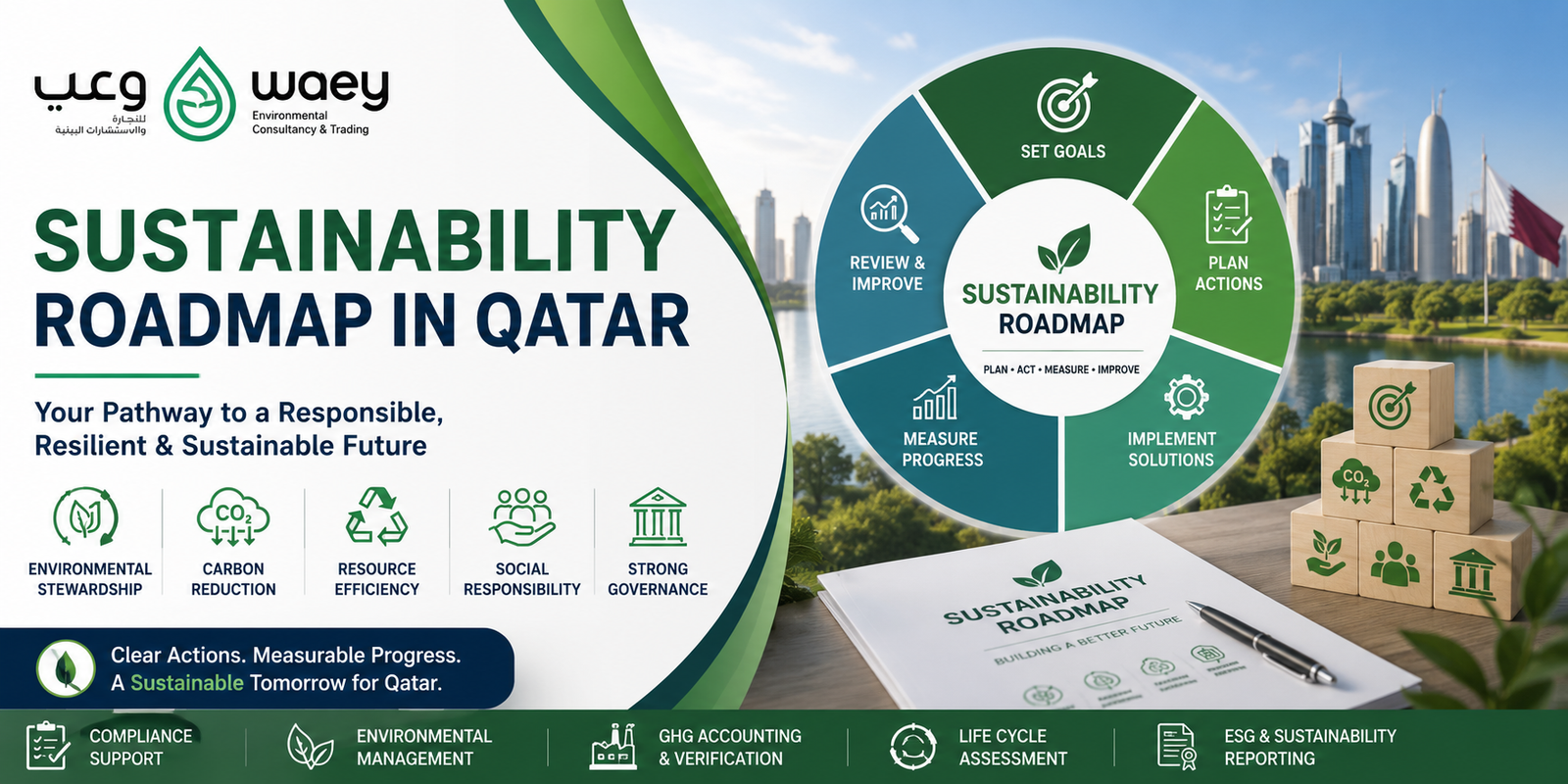
 A Sustainability Roadmap in Qatar helps a business move from general environmental intentions to clear, measurable, and practical action. Many companies want to reduce environmental impact, improve ESG performance, manage emissions, reduce waste, meet client requirements, and align with Qatar’s sustainability direction. The challenge is knowing where to start and how to turn those goals into a structured plan.A sustainability roadmap gives that structure.It connects the company’s current environmental performance with future targets, responsibilities, timelines, data collection, reporting needs, and improvement actions. Instead of treating sustainability as a one-time report or marketing message, a roadmap makes it part of business planning, operations, procurement, project delivery, and management review.
For businesses in Qatar, this is becoming more important. National priorities, project requirements, investor expectations, supply chain demands, ESG reporting, carbon reduction, environmental permits, and operational compliance are all pushing companies to manage sustainability in a more organized way.
This guide explains what a sustainability roadmap is, why it matters in Qatar, what it should include, and how Waey Environmental Consultancy & Trading can support businesses in building a practical roadmap that is suitable for real operations.
What Is a Sustainability Roadmap?
A sustainability roadmap is a step-by-step plan that helps a business improve its environmental and sustainability performance over time.
It usually starts with a review of the current situation. This may include energy use, water use, waste generation, greenhouse gas emissions, environmental permits, compliance records, procurement practices, operational risks, and ESG-related data.
After understanding the current position, the business can set priorities, define targets, assign responsibilities, and create a timeline for improvement.
In simple terms, a sustainability roadmap answers four important questions:
- Where are we now?
- Where do we need to improve?
- What actions should we take first?
- How will we measure progress?
A good roadmap should be realistic. It should match the company’s size, sector, budget, operations, compliance needs, and long-term business goals.
Why Businesses in Qatar Need a Sustainability Roadmap
Qatar’s development is closely linked with environmental responsibility, resource efficiency, climate action, and sustainable growth. Qatar National Vision 2030 highlights environmental development as one of the country’s main pillars, with a focus on balancing economic growth, social development, and environmental protection.
At the same time, businesses are facing more pressure from clients, regulators, investors, contractors, international partners, and supply chains. Many organizations are now expected to show how they manage emissions, waste, energy, water, environmental risks, and sustainability performance.
A sustainability roadmap helps companies respond to these expectations in a practical way.
It can support:
- Better environmental compliance
- Improved ESG performance
- Clearer carbon reduction planning
- Stronger environmental records
- Reduced waste and resource use
- Better tender and client submission support
- Improved internal accountability
- More organized sustainability reporting
- Long-term cost control through efficiency improvements
Without a roadmap, sustainability efforts can become scattered. One department may track waste, another may track energy, another may handle permits, and another may prepare ESG information. When these activities are not connected, the company may struggle to show clear progress.
A roadmap brings these actions together.
Sustainability Roadmap vs ESG Strategy
A sustainability roadmap and an ESG strategy are closely connected, but they are not exactly the same.
An ESG strategy usually focuses on environmental, social, and governance performance at the business level. It may include reporting, policies, leadership responsibilities, stakeholder expectations, risk management, and performance indicators.
A sustainability roadmap is often more action-focused. It shows the practical steps needed to improve performance over a specific period.
For example, ESG may identify carbon emissions as a key issue. The sustainability roadmap will explain what the business will do about it, such as measuring fuel use, preparing a GHG inventory, improving energy efficiency, setting reduction targets, training staff, and reviewing progress every quarter.
Businesses that want stronger ESG performance can benefit from connecting their roadmap with Environmental, Social, and Governance ESG in Qatar support.
What Should a Sustainability Roadmap Include?
A strong sustainability roadmap should be clear, practical, and measurable. It should not be filled with broad statements that are difficult to implement.
Below are the key sections that businesses in Qatar should consider.
1. Current Sustainability Baseline
The first step is understanding the company’s current position.
This may include reviewing:
- Energy consumption
- Water consumption
- Fuel use
- Waste generation
- Waste disposal records
- Environmental permits
- Monitoring reports
- Operational environmental risks
- Procurement practices
- Existing policies and procedures
- Training records
- ESG or sustainability reports, if available
This baseline helps the company understand what is already working and where improvement is needed.
For businesses with operational sites, the baseline may also connect with an Environmental Management Plan in Qatar, especially where environmental risks, controls, monitoring, and incident response need to be documented properly.
2. Compliance and Permit Review
Sustainability should start with compliance.
Before setting future goals, a business should understand whether it is meeting current environmental requirements. This may include environmental approvals, permit conditions, monitoring obligations, reporting requirements, waste disposal records, and site-level environmental controls.
A company may have strong sustainability ambitions, but if basic compliance records are weak, the roadmap will not be reliable.
Businesses that need help with approvals, renewals, or documentation can review Environmental Permit Support in Qatar to understand how permit-related planning supports better environmental performance.
3. Material Sustainability Topics
Not every sustainability issue has the same importance for every business.
A logistics company may focus on fuel use, vehicle emissions, packaging, and warehouse energy. A manufacturing company may focus on process emissions, waste, water use, product lifecycle impacts, and resource efficiency. A construction-related business may focus on materials, dust, waste, environmental permits, and contractor controls.
The roadmap should identify the most relevant sustainability topics for the business.
Common topics include:
- Energy efficiency
- GHG emissions
- Water conservation
- Waste reduction
- Recycling and circularity
- Air emissions
- Environmental monitoring
- Responsible procurement
- Product lifecycle impact
- Environmental compliance
- Staff awareness
- Contractor performance
Choosing the right topics helps the business avoid wasting time on areas that do not create meaningful value.
4. GHG and Carbon Accounting
Greenhouse gas emissions are now one of the most important parts of sustainability planning.
A sustainability roadmap should explain how the company will collect emissions data, calculate its carbon footprint, improve data quality, and reduce emissions over time.
This may include:
- Electricity consumption
- Fuel use
- Company vehicles
- Generators
- Refrigerants
- Business travel
- Waste-related emissions
- Supply chain-related emissions, where relevant
Companies that want an audit-ready carbon inventory can connect their roadmap with GHG Accounting and Verification in Qatar. This helps create a stronger basis for carbon reporting, reduction targets, and ESG disclosure.
5. Energy and Water Efficiency Actions
Energy and water are practical areas where many companies can make visible improvements.
The roadmap may include actions such as:
- Tracking monthly electricity use
- Reviewing high-consumption equipment
- Improving preventive maintenance
- Reducing unnecessary lighting or cooling losses
- Monitoring water use by area or activity
- Fixing leaks quickly
- Using efficient fixtures where suitable
- Training staff to reduce avoidable consumption
These actions may look simple, but they can create measurable improvement when they are tracked properly.
6. Waste Reduction and Circularity
Waste is another key area for a sustainability roadmap.
The business should understand what waste it generates, how much is produced, where it comes from, how it is stored, who collects it, and where it goes after collection.
The roadmap may include:
- Waste stream mapping
- Improved segregation
- Reduction of single-use materials
- Better storage and labelling
- Recycling opportunities
- Approved waste contractor review
- Waste transfer documentation
- Monthly waste reporting
- Staff training on waste handling
For companies with operational sites, waste controls should also be connected to the environmental management plan and compliance monitoring process.
7. Environmental Monitoring and Performance Tracking
A roadmap should include clear indicators to track progress.
These indicators may include electricity use, water use, fuel use, waste volume, recycling rate, emissions, monitoring results, incidents, complaints, training completion, corrective actions, and permit-related submissions.
For sites that require regular inspection or monitoring, Environmental Compliance Monitoring in Qatar can help keep records organized and support better follow-up.
Where environmental sampling or field measurement is needed, businesses may also need Environmental Monitoring Services in Qatar to track air, noise, water, wastewater, soil, or other relevant parameters.
8. Product and Lifecycle Considerations
For product-based businesses, contractors, manufacturers, construction material suppliers, and companies involved in procurement, sustainability should not stop at site operations.
It should also look at the lifecycle impact of products, materials, and services.
This is where Life Cycle Assessment in Qatar can support better decision-making. LCA helps evaluate environmental impacts across different lifecycle stages, such as raw materials, production, transportation, use, and end-of-life.
For businesses that need product transparency, an Environmental Product Declaration EPD can help communicate verified environmental information based on lifecycle data.
9. Responsibilities and Governance
A sustainability roadmap needs clear ownership.
If responsibilities are not assigned, actions may remain only on paper.
The roadmap should identify who is responsible for:
- Data collection
- Energy tracking
- Water tracking
- Waste records
- GHG accounting support
- Environmental monitoring
- Permit follow-up
- Internal reporting
- Training
- Corrective action closure
- Management review
Responsibilities may sit with the HSE team, facility manager, operations manager, procurement team, finance team, sustainability lead, or top management depending on the business structure.
10. Timeline and Action Plan
A roadmap should include a realistic timeline.
Not every action can be completed at once. Some actions can be done quickly, while others need budget, technical review, staff training, data collection, or management approval.
A practical roadmap may divide actions into:
- Immediate actions within 1 to 3 months
- Short-term actions within 3 to 6 months
- Medium-term actions within 6 to 12 months
- Long-term actions over 1 to 3 years
This makes implementation easier and helps the company show steady progress.
Example Sustainability Roadmap Structure
A simple roadmap for a business in Qatar may look like this:
Phase 1: Baseline Review
- Review current environmental records
- Check permits and compliance obligations
- Collect energy, water, fuel, and waste data
- Identify major environmental risks
- Review current policies and procedures
Phase 2: Priority Setting
- Select the most important sustainability topics
- Identify quick improvement opportunities
- Set measurable indicators
- Assign responsibilities
- Prepare an action tracker
Phase 3: Implementation
- Improve monitoring and recordkeeping
- Train relevant staff
- Start waste and resource efficiency actions
- Begin GHG data collection
- Update environmental management procedures
Phase 4: Reporting and Review
- Review progress monthly or quarterly
- Track KPIs
- Close corrective actions
- Prepare management reports
- Update roadmap targets when needed
This structure can be adjusted based on business size, sector, project requirements, and management goals.
How a Sustainability Roadmap Supports Tenders and Client Requirements
Many companies in Qatar work with clients who ask for environmental documentation, ESG information, carbon data, environmental policies, waste records, or sustainability commitments.
A sustainability roadmap can help the business respond with stronger evidence.
Instead of giving general statements, the company can show:
- Current baseline data
- Improvement targets
- Action plans
- Monitoring records
- Training records
- GHG accounting progress
- Waste reduction actions
- Environmental compliance controls
This can support tenders, supplier registration, prequalification, client audits, and internal management reporting.
For infrastructure-related projects, companies may also need stronger documentation aligned with environmental expectations. Businesses can review Ashghal PWA Approved Environmental Consultancy in Qatar for related environmental documentation and compliance checklist guidance.
How Sustainability Roadmap Connects With EIA and CEMP
For new projects, sustainability planning should also connect with the early environmental approval process.
An Environmental Impact Assessment in Qatar may identify project impacts and mitigation measures before approval or development. A Construction Environmental Management Plan in Qatar may then control construction-stage impacts.
The sustainability roadmap can connect these project-stage controls with long-term operational goals.
For example, if the EIA identifies water use as a concern, the roadmap can include water efficiency targets. If the CEMP identifies construction waste issues, the roadmap can include improved waste segregation and contractor controls. If the project has energy-intensive operations, the roadmap can include carbon accounting and efficiency actions.
This makes sustainability planning more complete and more useful for the business.
Useful Qatar Sustainability References
Businesses preparing a sustainability roadmap in Qatar may refer to official national resources and environmental guidance to understand the wider direction of sustainability and climate action in the country.
- Qatar National Vision 2030
- Ministry of Environment and Climate Change 2024-2030 Strategy
- Third Qatar National Development Strategy 2024-2030
- Qatar National Climate Change Action Plan
Common Mistakes Businesses Make When Preparing a Sustainability Roadmap
A sustainability roadmap should be practical. Many companies make the mistake of preparing a document that sounds good but does not guide action.
Common mistakes include:
- Using broad goals without measurable targets
- Not starting with a proper baseline
- Ignoring environmental compliance requirements
- Not assigning clear responsibilities
- Tracking too many KPIs without knowing which ones matter
- Not connecting sustainability with operations
- Not collecting reliable data
- Setting targets without a timeline
- Leaving procurement and contractors out of the plan
- Preparing ESG statements without supporting records
- Not reviewing progress regularly
The best roadmap is not always the longest document. It is the one that helps the business take action, track progress, and improve performance.
How Waey Supports Sustainability Roadmap Development in Qatar
Waey Environmental Consultancy & Trading supports businesses in Qatar with environmental and sustainability planning that is practical, measurable, and suitable for real operations.
Waey can support sustainability roadmap development through:
- Sustainability baseline review
- Environmental compliance review
- Environmental permit condition review
- Energy, water, waste, and emissions data review
- GHG accounting planning
- ESG improvement planning
- Environmental monitoring planning
- Waste reduction and resource efficiency actions
- Operational environmental management support
- LCA and EPD support for product-based businesses
- Roadmap action tracker preparation
- Management review and progress reporting support
The goal is to help businesses move from intention to implementation. A roadmap should not remain as a presentation or policy file. It should help the company make better decisions, improve records, reduce environmental risk, and show measurable progress over time.
Final Thoughts
A Sustainability Roadmap in Qatar gives businesses a practical way to manage environmental performance, ESG expectations, carbon reduction, resource efficiency, waste management, and compliance improvement.
It helps companies understand their current position, choose the right priorities, set realistic targets, assign responsibilities, and measure progress.
For businesses operating in Qatar, this kind of planning is becoming more important as national sustainability goals, client expectations, climate action, environmental compliance, and ESG requirements continue to shape the market.
If your company wants to build a practical sustainability roadmap, improve environmental records, prepare for ESG reporting, or organize carbon and compliance data, Waey can support you with clear planning and technical guidance.
For support, contact Waey Environmental Consultancy & Trading through the official website or email info@waey.qa.
Frequently Asked Questions
What is a sustainability roadmap?
A sustainability roadmap is a structured action plan that helps a business improve environmental and sustainability performance over time. It usually includes baseline review, priority areas, targets, responsibilities, timelines, data tracking, and progress reporting.
Why is a sustainability roadmap important in Qatar?
A sustainability roadmap helps businesses in Qatar align with environmental priorities, improve ESG performance, manage emissions, reduce waste, track resources, support compliance, and respond to client or project requirements.
What should be included in a sustainability roadmap?
A sustainability roadmap should include current baseline data, environmental compliance review, material sustainability topics, GHG accounting actions, energy and water efficiency plans, waste reduction actions, KPIs, responsibilities, timelines, and reporting methods.
How does a sustainability roadmap support ESG?
It gives the business measurable actions and records that support ESG reporting. Instead of making general sustainability claims, the company can show data, targets, progress, and corrective actions.
Can a sustainability roadmap help reduce carbon emissions?
Yes. A roadmap can include GHG accounting, energy efficiency actions, fuel tracking, operational improvements, renewable energy review, and emission reduction targets.
Who should prepare a sustainability roadmap?
A sustainability roadmap should be prepared with input from management, HSE, operations, procurement, facility teams, finance, and an experienced environmental or sustainability consultant.
Can Waey prepare a sustainability roadmap for businesses in Qatar?
Yes. Waey can support businesses with sustainability baseline review, ESG planning, GHG accounting support, environmental compliance review, monitoring planning, LCA, EPD, and practical roadmap development.