Carbon Footprint Assessment in Qatar: A Practical Guide to Scope 1, 2 and 3 Emissions
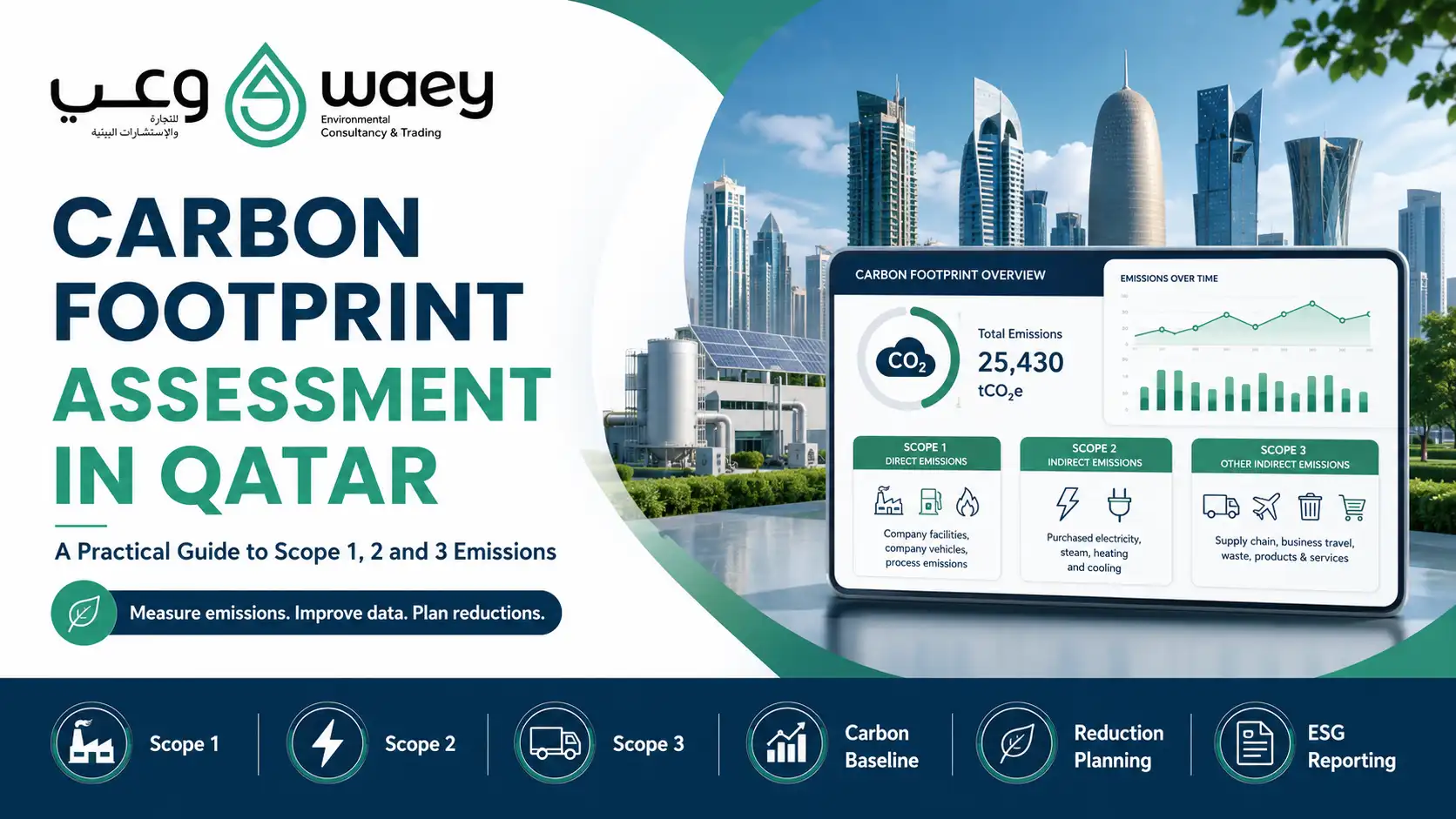
A Carbon Footprint Assessment in Qatar gives a business much more than a single emissions number. When done properly, it shows where greenhouse gas emissions come from, which data the company can rely on, where information is still missing, and where reduction efforts may create the greatest impact.
For many companies, the first carbon footprint exercise begins with a simple request. A client may ask for emissions data, a tender may require a sustainability response, or a parent company may request Scope 1 and Scope 2 figures.
In other cases, an ESG report needs carbon information, or management simply wants to know whether energy and fuel reduction programmes are producing measurable results.
However, the real difficulty often begins when the team starts looking for the data.
Electricity bills may sit with finance, while operations may hold fuel records. Facilities teams may manage generator consumption and refrigerant information. Meanwhile, vehicle records could sit with administration, and waste or transport data may come from external contractors.
As a result, a reliable carbon footprint assessment requires more than a calculation spreadsheet. It needs a clear boundary, consistent records, an agreed methodology, and supporting evidence.
This guide explains how organizations can approach carbon footprint assessment, what Scope 1, Scope 2 and Scope 3 mean, which records are normally needed, where calculation errors commonly occur, and how Waey Environmental Consultancy & Trading can support businesses with carbon and GHG accounting.
What Does a Carbon Footprint Assessment in Qatar Include?
A Carbon Footprint Assessment in Qatar measures greenhouse gas emissions associated with an organization, activity, product, service, or other clearly defined boundary.
For a corporate assessment, the process usually covers emissions generated directly by the organization as well as relevant indirect emissions connected with its operations and value chain.
Therefore, the assessment gives management a clearer picture of where emissions originate and which sources deserve the most attention.
Companies normally express the final result as carbon dioxide equivalent, or CO2e. This common unit allows different greenhouse gases to be compared according to their contribution to global warming.
Importantly, a useful assessment should answer more than one question.
It should not stop at:
“What is our total carbon footprint?”
Instead, it should also answer:
- Which operations are included?
- Which locations are included?
- What reporting period does the assessment cover?
- Which emission sources have been identified?
- What activity data supports the calculations?
- Which emission factors were used?
- What assumptions were made?
- Which Scope 3 categories are relevant?
- Where are the largest emissions?
- Can another reviewer trace the calculation back to the original records?
That last question matters greatly.
A carbon footprint may look accurate in a presentation. However, the number becomes far more useful when someone can trace it back to invoices, utility bills, fuel logs, maintenance reports, travel records, waste reports, and calculation files.
Why Carbon Footprint Assessment in Qatar Is Becoming More Important
Carbon Footprint Assessment in Qatar is increasingly relevant as companies pay more attention to emissions, sustainability performance, resource efficiency, and environmental reporting.
Qatar’s wider environmental development direction also places importance on climate action and responsible resource management. Businesses can review the official Qatar National Vision 2030 environmental development priorities for the broader national context.
At the same time, commercial requirements can be just as important as national environmental goals. Clients, contractors, investors, parent companies, and international supply chains increasingly ask businesses to provide reliable emissions information.
For example, a company may need carbon or GHG information during:
- Supplier registration
- Client prequalification
- Tender submissions
- ESG reporting
- Sustainability reporting
- Group-level carbon reporting
- Investor questionnaires
- International supply-chain assessments
- Internal sustainability planning
Consequently, businesses that establish a reliable carbon baseline before these requests become urgent are usually better prepared than companies trying to reconstruct several years of information at the last minute.
Carbon Footprint Assessment and GHG Accounting: Are They the Same?
The terms carbon footprint assessment and GHG accounting are often used together. Although they are closely related, they describe slightly different parts of the process.
A carbon footprint assessment generally describes the exercise of measuring greenhouse gas emissions associated with a defined organization, activity, product, or service.
GHG accounting focuses more specifically on the structured process used to identify, quantify, classify, document, and report those emissions.
For corporate assessments, recognized methodologies such as the GHG Protocol Corporate Standard provide a framework for preparing an organizational GHG inventory.
In addition, businesses looking for a deeper explanation of inventory preparation can read Waey’s guide to GHG Accounting & Verification in Qatar.
Scope 1, Scope 2 and Scope 3 Emissions Explained
One of the first things a business needs to understand is how greenhouse gas emissions are divided into different scopes.
The three scopes help organizations classify where emissions come from and how closely those emissions relate to their own operations.
Scope 1: Direct Emissions
Scope 1 covers direct greenhouse gas emissions from sources that the organization owns or controls within the reporting boundary.
For a business in Qatar, typical Scope 1 sources may include:
- Diesel used in company generators
- Petrol or diesel used in company-owned vehicles
- Fuel used in boilers or process equipment
- Refrigerant leakage from air-conditioning or cooling systems
- Process emissions from certain industrial activities
Scope 1 may appear straightforward. However, companies frequently overlook important emission sources.
For example, a business may include vehicle fuel and generator diesel but forget refrigerant leakage. Another company may calculate fuel consumption from purchase invoices without checking opening and closing fuel stock.
Therefore, the assessment should begin with a complete emission-source inventory before the team starts the calculations.
Scope 2: Purchased Energy
Scope 2 mainly relates to indirect emissions associated with purchased or acquired electricity, steam, heat, or cooling used by the reporting organization.
For many offices, warehouses, commercial facilities, and service companies in Qatar, purchased electricity can represent an important part of the corporate footprint.
The GHG Protocol Scope 2 Guidance provides specific guidance on accounting for emissions from purchased energy.
Useful supporting records may include:
- Electricity bills
- Meter readings
- Landlord electricity statements
- Utility consumption reports
- Site allocation calculations for shared facilities
In addition, businesses with several offices, warehouses, or project locations should confirm that every relevant location falls within the agreed reporting boundary.
Otherwise, missing a major site can affect the final result and make year-on-year comparisons less reliable.
Scope 3: Value Chain Emissions
Scope 3 covers other indirect emissions that occur across the organization’s value chain.
This area can become more complicated because much of the required information sits outside the company’s direct control.
The GHG Protocol Corporate Value Chain Scope 3 Standard identifies 15 categories covering upstream and downstream activities.
Depending on the nature of the company, potentially relevant Scope 3 sources may include:
- Purchased goods and services
- Capital goods
- Fuel and energy-related activities not included in Scope 1 or Scope 2
- Upstream transportation and distribution
- Waste generated in operations
- Business travel
- Employee commuting
- Upstream leased assets
- Downstream transportation and distribution
- Processing of sold products
- Use of sold products
- End-of-life treatment of sold products
- Downstream leased assets
- Franchises
- Investments
Not every category will be equally relevant to every company. Therefore, businesses should first screen the categories and identify those that matter most to their operations.
After that, the assessment can focus on areas where meaningful value-chain emissions are most likely to occur. This approach keeps the work focused while improving the usefulness of the final inventory.
Data Needed for Carbon Footprint Assessment in Qatar
A Carbon Footprint Assessment in Qatar depends heavily on the quality of the activity data supplied by the organization.
Before calculations begin, the company should create a data-request list that matches its actual operations.
Fuel Data
Fuel information may include:
- Diesel purchase records
- Petrol records
- Fuel card statements
- Generator logs
- Fleet fuel reports
- Tank filling records
Where possible, compare purchase records with actual operating information. This helps identify duplicate records, missing months, or unusual fuel movements.
Electricity Data
Electricity information may include:
- Monthly electricity bills
- Annual electricity summaries
- Meter readings
- Landlord utility statements
- Allocation records for shared buildings
For shared facilities, document the allocation method clearly so another reviewer can understand how the company calculated its share of consumption.
Refrigerant Data
Refrigerant information may include:
- Refrigerant refill records
- Maintenance reports
- Equipment registers
- Refrigerant type
- Quantity added during maintenance
In practice, this information often sits with maintenance or facility contractors rather than the sustainability team. Early coordination can therefore prevent data gaps.
Transport and Travel Data
Relevant records may include:
- Company vehicle mileage
- Fuel use
- Rental vehicle records
- Air travel information
- Taxi records
- Logistics data
Similarly, businesses should make sure transport records cover the same reporting period used for the rest of the inventory.
Waste Data
Waste information may include:
- Waste quantities
- Waste type
- Waste contractor reports
- Disposal route
- Recycling records
Where reliable weight data is available, use it instead of unsupported estimates.
Purchased Goods and Services
Depending on the agreed Scope 3 boundary, procurement information may also be needed.
This can involve quantities, spend data, supplier information, or product-specific environmental information.
However, the collection method should match the agreed methodology and the level of detail needed for the assessment.
Start With the Organizational Boundary
One of the easiest ways to create an unreliable carbon inventory is to start calculating before agreeing on the reporting boundary.
Imagine a company has:
- A head office in Doha
- A warehouse
- Two project sites
- Company vehicles
- Leased equipment
- An overseas branch
Which of these operations belong in the footprint?
The company should answer this question before data collection begins.
First, the methodology should explain how the organization decides which companies, facilities, and activities belong within the inventory.
Once the company agrees on this boundary, different departments can collect information using the same scope. As a result, the business reduces the risk of missing facilities or producing conflicting datasets.
Select a Clear Reporting Period
Another basic decision involves the reporting period.
For example, a company may assess emissions for a calendar year or use its financial reporting year.
Whatever reporting period the company chooses, it should use that period consistently across the inventory.
For instance, problems arise when electricity information covers January to December, fuel records cover April to March, and waste records cover only eight months.
If the team cannot avoid different periods, it should clearly document the treatment and assumptions.
This way, reviewers can understand exactly how the company reached the final figures.
How Carbon Footprint Assessment in Qatar Calculations Work
At a basic level, a Carbon Footprint Assessment in Qatar often uses activity data together with an appropriate emission factor.
Activity Data × Emission Factor = GHG Emissions
However, multiplying activity data by an emission factor is only one part of a professional assessment.
The calculation team should also consider:
- Correct units
- Appropriate emission factors
- Reporting boundaries
- Data quality
- Conversion factors
- Global warming potential values
- Applicable methodology
- Assumptions
- Data gaps
- Double counting
For this reason, a spreadsheet filled with numbers does not automatically become a reliable GHG inventory.
Instead, the methodology, source data, assumptions, and supporting evidence matter just as much as the final calculation.
What Does ISO 14064-1 Have to Do With Carbon Footprinting?
ISO 14064-1 sets out principles and requirements for organization-level quantification and reporting of greenhouse gas emissions and removals.
It covers areas such as the design, development, management, and reporting of an organization’s GHG inventory.
Therefore, businesses that want their carbon inventory to support formal reporting or verification should decide their intended methodology early.
Trying to restructure an incomplete calculation after the reporting work has finished usually takes more time than building the inventory correctly from the start.
For additional support, Waey’s GHG and Carbon Accounting services in Qatar help businesses that need structured greenhouse gas assessment and reporting.
Corporate Carbon Footprint vs Product Carbon Footprint
Importantly, a corporate carbon footprint and a product carbon footprint answer different questions.
A corporate carbon footprint looks at greenhouse gas emissions associated with an organization within a defined reporting boundary.
By comparison, a product carbon footprint looks at emissions associated with a specific product across defined stages of its lifecycle.
For example, a construction-material manufacturer may want answers to two different questions.
Corporate question: How much GHG does our company emit during the reporting year?
Product question: What is the carbon impact associated with one defined unit of our product?
Because these questions are different, they require different boundaries and, in some cases, different datasets.
The product-level question may require a lifecycle-based approach.
Manufacturers interested in product environmental performance can review Waey’s Life Cycle Assessment services in Qatar.
What Is a Carbon Baseline?
A carbon baseline gives the company a defined starting point for future comparison.
For example, management may select one reporting year as its base year and compare future emissions against that inventory.
Over time, this makes it easier to understand whether emissions are increasing, decreasing, or changing because the business itself has grown.
A good baseline can answer questions such as:
- Are total emissions increasing or decreasing?
- Is energy efficiency improving?
- Has fuel consumption changed?
- Did operational growth cause emissions to increase?
- Are reduction measures producing measurable results?
Without a reliable baseline, a business may find it difficult to show whether carbon reduction claims are supported by actual data.
Absolute Emissions vs Emissions Intensity
Total emissions are important. However, they do not always tell the full story.
Imagine that a company expands production significantly. Its total emissions may increase even though the amount of carbon emitted per unit of production decreases.
In this situation, emissions intensity can provide useful additional context.
Depending on the business, useful intensity indicators may include:
- tCO2e per tonne of product
- tCO2e per employee
- tCO2e per square metre
- tCO2e per project
- tCO2e per unit of revenue
- tCO2e per kilometre travelled
The correct metric depends on the nature of the organization.
Therefore, companies should review both absolute emissions and relevant intensity indicators when assessing performance.
Common Carbon Footprint Assessment in Qatar Mistakes
A Carbon Footprint Assessment in Qatar can lose reliability because of weak boundaries, incomplete information, inconsistent datasets, or poor documentation rather than complicated mathematics.
Leaving Out a Facility
First, a company may calculate electricity for its head office but forget a warehouse, branch, or project office.
Consequently, the reporting boundary becomes incomplete and may distort comparisons with future years.
Ignoring Refrigerants
Another common gap involves refrigerants.
The facilities team may maintain air-conditioning systems regularly, while the carbon-accounting team may never receive the refrigerant refill records.
Double Counting Fuel
Likewise, fuel can appear twice when one department records purchase invoices while another records the same consumption through vehicle or generator statements.
Therefore, a clear source hierarchy can help prevent this problem.
Using Inconsistent Units
In addition, teams sometimes combine litres, kilograms, tonnes, cubic metres, and other units without applying the correct conversions.
For this reason, unit control should form part of the calculation review.
Mixing Reporting Periods
Meanwhile, combining data from different reporting periods without explanation can distort the final inventory.
The reporting file should clearly show which period each dataset covers.
Using Unsupported Estimates
Estimation may sometimes be necessary. However, the team should use a reasonable method and document it clearly.
Whenever better primary data becomes available, the company should consider replacing weak estimates.
Calculating Scope 3 Without Screening Relevance
Another mistake is collecting large amounts of Scope 3 information before deciding which categories actually matter to the organization.
Instead, a screening exercise can make the process more focused and useful.
No Evidence File
Finally, some companies produce a final carbon figure but cannot locate the records that support it.
Without a proper evidence file, future review, verification, or recalculation becomes much harder.
How to Make Your Carbon Footprint Audit-Ready
Even if formal third-party verification is not required immediately, preparing the inventory as though another person will review it usually improves its quality.
For this purpose, keep a structured evidence folder containing:
- Organizational boundary document
- Reporting period information
- Emission source register
- Electricity bills
- Fuel records
- Vehicle information
- Refrigerant records
- Waste reports
- Travel information
- Emission factors
- Calculation files
- Assumptions register
- Data-gap notes
- Management review records
In addition, keep calculation files easy to follow. Another reviewer should be able to identify the source data, emission factor, unit conversion, and final result without having to guess how the calculation works.
Finally, use clear file names and link each supporting record to the relevant calculation wherever possible. This simple practice makes future reviews much easier.
Carbon Footprint Assessment and ESG Reporting
Carbon emissions commonly form an important part of the environmental component of ESG reporting.
However, an ESG report should not contain emissions figures that the company cannot trace back to reliable calculations.
A structured carbon footprint can provide:
- Scope 1 emissions
- Scope 2 emissions
- Relevant Scope 3 information
- Year-on-year comparisons
- Intensity metrics
- Reduction actions
- Methodology notes
As a result, good carbon accounting improves the quality of environmental information available for ESG reporting.
Companies developing broader sustainability disclosures can connect their carbon work with Environmental, Social and Governance ESG services in Qatar.
From Carbon Footprint to Carbon Reduction
Measurement is only the starting point.
Once the assessment identifies the largest emission sources, management can decide where reduction efforts may create the greatest value.
Possible areas can include:
- Energy efficiency
- Equipment upgrades
- Generator optimization
- Fleet efficiency
- Refrigerant management
- Waste reduction
- Procurement changes
- Renewable energy options
- Supplier engagement
- Travel policies
Therefore, businesses should prioritize reduction measures based on evidence rather than trying to implement every available sustainability idea at once.
For example, if electricity creates a major share of the footprint, energy efficiency may deserve more attention than a small travel-related initiative.
On the other hand, a logistics-heavy business may find that vehicle fuel and transport-related Scope 3 emissions require greater focus.
Connect Carbon Reduction With a Sustainability Roadmap
A carbon footprint becomes much more useful when the results feed into a longer-term action plan.
For instance, the business may establish:
- A baseline year
- Key emission sources
- Reduction opportunities
- Responsible departments
- Required budget
- Performance indicators
- Review frequency
- Future reporting milestones
By connecting these elements, the company can move from calculation to practical action.
Waey’s guide to building a Sustainability Roadmap in Qatar explains how carbon actions can sit alongside energy, water, waste, compliance, and ESG priorities.
Who Inside the Company Should Be Involved?
Carbon accounting should not sit with one department when the required information comes from across the organization.
Instead, a practical carbon-data team may involve several departments.
Finance
Finance may hold electricity bills, fuel invoices, procurement spend, and travel costs.
Facilities
Facilities teams may hold generator logs, air-conditioning maintenance records, building energy information, and refrigerant data.
Operations
Operations often provides production figures, fuel use, equipment data, and information about day-to-day activities.
Procurement
Procurement can provide supplier information, purchased goods data, and contract details that may support Scope 3 calculations.
HSE or Sustainability
This team may coordinate boundaries, methodology, evidence, review, and reporting.
Human Resources
Human Resources may provide employee numbers, commuting information, or workforce data needed for selected indicators.
By agreeing responsibilities early, the company can reduce delays and avoid repeatedly asking different departments for the same information.
How Often Should a Company Calculate Its Carbon Footprint?
For businesses using carbon information for annual ESG, sustainability, or corporate reporting, an annual organizational inventory is common.
However, companies do not need to wait until year-end to collect the underlying data.
Instead, key information can be gathered monthly or quarterly.
For example:
- Electricity: monthly
- Fuel: monthly
- Refrigerants: after maintenance events
- Waste: monthly
- Business travel: monthly or quarterly
As a result, the final year-end assessment becomes easier because the records already exist in an organized format.
Regular data collection can also help management identify unusual consumption patterns before the reporting year closes.
Carbon Footprint Assessment in Qatar Readiness Checklist
Before starting a Carbon Footprint Assessment in Qatar, businesses should confirm that the basic reporting structure and supporting records are ready.
Ask the following questions:
- Have we defined the reporting organization?
- Have we selected the reporting period?
- Do we have a list of all offices, facilities, and sites?
- Have we identified Scope 1 sources?
- Do we have complete electricity data?
- Have we checked refrigerants?
- Have we screened relevant Scope 3 categories?
- Are supporting records available?
- Do we know which methodology we will use?
- Do we have previous-year data?
- Do we expect formal verification?
- Who will approve the final inventory?
If several answers are “no,” a carbon-data readiness review may be useful before the main calculation begins.
That early review can identify missing data while the company still has time to obtain it.
How Carbon Footprint Assessment Supports Better Business Decisions
A good carbon footprint can support more than sustainability reporting.
For example, the assessment may show that an older generator consumes much more fuel than expected. It may also reveal unusually high electricity use at one facility or show that logistics contribute more to value-chain emissions than management assumed.
These findings can support decisions about:
- Equipment replacement
- Energy efficiency
- Fleet management
- Procurement
- Supplier engagement
- Waste reduction
- Operational planning
- Budget priorities
Therefore, carbon accounting can become a management tool rather than simply another annual reporting exercise.
Carbon Footprint Assessment and Environmental Management
Carbon management should also connect with the wider environmental controls of the business.
Fuel, energy, waste, maintenance, refrigerants, transportation, and operational efficiency often appear in both environmental management and carbon accounting.
Because of this overlap, companies may find it useful to connect carbon data with their Environmental Management Plan in Qatar.
This connection can improve internal ownership and help ensure that environmental improvement actions support measurable carbon reductions where relevant.
Carbon Footprint Assessment and Environmental Compliance
A carbon footprint assessment is different from environmental compliance monitoring. Nevertheless, the two areas can support each other.
For example, generator records may support both emissions calculations and environmental inspections. Likewise, waste records may support Scope 3 calculations while also providing evidence of proper waste management.
Facilities that need better control of inspection records and environmental evidence can also review Waey’s guide to Environmental Compliance Monitoring in Qatar.
How Waey Supports Carbon Footprint Assessment in Qatar
Waey supports businesses that need a structured Carbon Footprint Assessment in Qatar, including organizational emissions assessment, data review, GHG inventory development, and carbon-reduction planning.
Waey Environmental Consultancy & Trading can support organizations depending on the purpose and agreed project scope.
Support may include:
- Carbon footprint readiness review
- Organizational and operational boundary development
- Emission source identification
- Scope 1 assessment
- Scope 2 assessment
- Relevant Scope 3 assessment
- Data requirement checklist preparation
- Activity data review
- GHG calculations
- Carbon baseline development
- Data-gap and assumption tracking
- GHG inventory reporting
- Verification preparation support
- Carbon reduction planning
- ESG and sustainability reporting support
In addition, businesses can review Waey’s dedicated GHG and Carbon Accounting services for related carbon-management support.
When Should You Start?
The best time to start is before somebody urgently asks for the final emissions number.
If a client requests carbon data tomorrow, a company that has never tracked generator fuel, refrigerants, travel, electricity, or waste may struggle to produce reliable information quickly.
In contrast, a company that already follows a monthly carbon-data process can respond much more confidently.
Even if full carbon reporting is not required today, establishing the basic data structure can make future GHG reporting considerably easier.
More importantly, early preparation gives the company time to improve weak records rather than relying on unsupported estimates later.
Final Thoughts
A Carbon Footprint Assessment in Qatar should not be treated as a spreadsheet exercise carried out once a year.
Instead, the useful part is understanding the business behind the number.
Where are emissions generated? Which data can the company trust? Which sources are missing? Which activities create the largest footprint? What can realistically improve?
When a business answers those questions clearly, its carbon footprint becomes a management tool rather than another reporting requirement.
It can support better ESG information, sustainability planning, client submissions, carbon reduction initiatives, and internal decision-making.
Therefore, the strongest carbon inventories combine good methodology with reliable data, clear evidence, consistent boundaries, and practical follow-up actions.
If your organization needs to establish its first carbon baseline, improve an existing GHG inventory, or prepare emissions data for review, request a quote from Waey or contact Waey Environmental Consultancy & Trading.
Frequently Asked Questions
What is a Carbon Footprint Assessment in Qatar?
A Carbon Footprint Assessment in Qatar identifies and calculates greenhouse gas emissions associated with a defined organization, activity, product, or service. Corporate assessments commonly classify emissions into Scope 1, Scope 2, and relevant Scope 3 categories.
What are Scope 1 emissions?
Scope 1 covers direct greenhouse gas emissions from sources owned or controlled by the organization. Examples may include company vehicles, generators, fuel combustion, process emissions, and certain refrigerant losses.
What are Scope 2 emissions?
Scope 2 mainly relates to indirect emissions associated with purchased or acquired energy used by the organization, particularly electricity.
What are Scope 3 emissions?
Scope 3 covers other indirect emissions across the value chain. Depending on the organization, this may include purchased goods, transportation, waste, business travel, employee commuting, leased assets, product use, and other upstream or downstream activities.
What information is needed for a corporate carbon footprint?
Typical information includes electricity consumption, fuel use, fleet data, generator records, refrigerant information, waste records, travel information, and relevant supply-chain data. However, the exact requirements depend on the agreed reporting boundary and methodology.
Is carbon footprint assessment the same as GHG verification?
No. A carbon footprint assessment creates the greenhouse gas inventory. Verification involves a separate review of reported information, calculations, methodology, and supporting evidence against agreed verification criteria.
What is the difference between a corporate carbon footprint and a product carbon footprint?
A corporate footprint assesses emissions associated with an organization. In comparison, a product carbon footprint assesses emissions associated with a specific product within a defined lifecycle boundary.
Can a carbon footprint assessment support ESG reporting?
Yes. A structured GHG inventory can provide emissions data, trends, intensity indicators, methodology information, and reduction actions that support the environmental part of ESG and sustainability reporting.
How often should a company calculate its carbon footprint?
Many organizations prepare an annual corporate GHG inventory. However, collecting electricity, fuel, waste, refrigerant, travel, and other activity data monthly or quarterly makes year-end reporting much easier.
Can Waey calculate Scope 1, Scope 2 and Scope 3 emissions in Qatar?
Yes. Waey provides GHG and carbon accounting support in Qatar, including emission-source identification, data review, carbon footprint calculations, GHG inventory reporting, verification preparation support, and carbon reduction planning based on the agreed project scope.