Ashghal (PWA) Approved Environmental Consultancy in Qatar: Requirements, Documents & Compliance Checklist (2026)
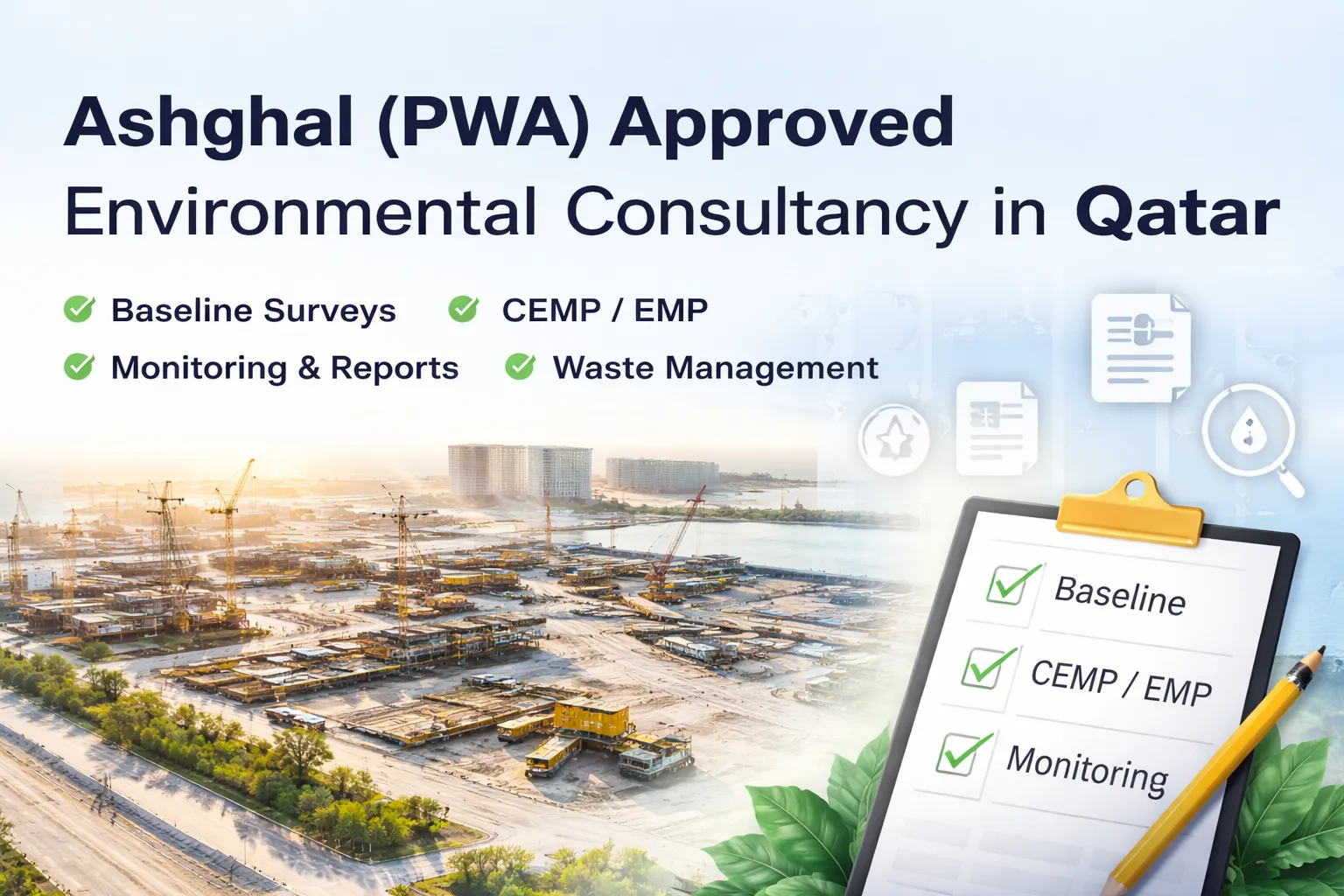
If you’re delivering a Public Works Authority project in Qatar (Ashghal / PWA), “Ashghal approved” for environmental services is often a practical
requirement—not a marketing label. Approval impacts who can perform certain environmental and sustainability activities on PWA projects and how you
evidence compliance during execution and at handover.
This guide breaks down what “Ashghal (PWA) Approved” means, the typical scope contractors need (baseline, CEMP/EMP controls, monitoring, waste/hazard controls),
and a step-by-step workflow that helps teams avoid delays, repeated revisions, and evidence gaps.
What “Ashghal (PWA) Approved” means for environmental services
Ashghal publishes an official list of approved companies/service providers that can deliver environmental management and sustainability services for
PWA projects. In practice, the “approved” status is linked to specific fields of activity—for example, terrestrial baseline survey, marine baseline
survey, environmental monitoring, waste-related activities, and other defined services.
The most important contractor takeaway is simple: don’t rely on a generic claim of being approved. Approval is often activity-specific, and Ashghal
updates lists periodically. Before appointing any provider, teams should confirm:
- The provider appears on the official list (with the latest revision date).
- The provider is approved for the exact field(s) of activity your project needs (baseline vs monitoring vs other activities).
- You retain a record of the list revision used at the time of appointment (useful for audits and closeout).
High-authority references (official):
Ashghal – Approved Companies List
|
Approved List PDF (example revision)
|
Ashghal Approval Process – Environmental Services (PDF)
confirm the scope early so you don’t end up repeating baseline or monitoring later.
Typical environmental scope on Ashghal projects in Qatar
Each PWA project is different, but most contractor needs fall into a repeatable set of tasks. Your scope should be shaped by project type, location,
receptors, contract requirements, and (where applicable) MoECC permit conditions.
1) Baseline environmental surveys (terrestrial / marine) and baseline reporting
A baseline survey documents the “before” condition so impacts can be assessed and defended. Baseline inputs also help you choose monitoring
locations and set realistic trigger/response actions. In sensitive areas, baseline quality is often scrutinized, so methodology, sampling points,
and documentation clarity matter.
2) CEMP / EMP preparation and implementation support
Construction Environmental Management Plans (CEMP) and Environmental Management Plans (EMP) translate requirements into daily site controls:
responsibilities, inspections, spill response, waste segregation, corrective action pathways, and reporting cadence. A strong plan is site-specific
and written around real risks—not generic template paragraphs.
Internal link (use only where relevant in your final post):
Environmental Management Plan (EMP) services.
3) Environmental compliance monitoring (air, noise, dust, water, marine, etc.)
Monitoring is how you prove performance over time. It can include routine inspections plus measured monitoring supported by accredited labs.
Evidence needs to be defensible: chain-of-custody, calibration references, method notes, and clear site context.
Internal link:
Environmental compliance monitoring.
4) Waste and hazardous waste controls
Waste controls are a daily discipline, not a monthly clean-up. Contractors usually need clear segregation, labeling, storage, secondary containment (where needed),
manifest control, subcontractor accountability, and inspection routines. If records are missing, it becomes hard to prove compliance at closeout.
5) Dewatering and discharge controls (where relevant)
If dewatering is part of your construction approach, align your planning, discharge controls, monitoring, and recordkeeping with guidance and project conditions.
A commonly referenced document is Ashghal’s construction dewatering guideline manual:
Ashghal – Construction Dewatering Guideline (PDF).
Ashghal vs MoECC in Qatar (and why alignment prevents delays)
In Qatar, environmental assessment and permitting are handled under the Ministry of Environment and Climate Change (MoECC), through its relevant departments.
If your project triggers permit conditions or environmental assessment requirements, those obligations still apply even when the project is delivered for Ashghal.
In other words, you should align both sets of expectations so you don’t have a “plan mismatch.”
High-authority references (official):
MoECC – Assessment and Permits Department
|
MoECC – Technical Guidance (Urban) (PDF)
Practical takeaway: Write baseline, CEMP/EMP, and monitoring plans so they can satisfy both project execution needs and external review expectations.
Teams that do this early typically reduce rework, avoid repeated baseline/monitoring, and keep evidence in one place for inspections and handover.
Internal link (Qatar-focused background):
Qatar EIA, environmental permits & CEMP compliance.
Step-by-step workflow to stay compliant on Ashghal projects
Use the workflow below as a practical process you can apply at kickoff and keep running through execution. Even experienced teams benefit from a written checklist,
because compliance issues often appear when the schedule accelerates and evidence becomes scattered.
- Confirm scope and receptors early.
Identify whether you need terrestrial baseline, marine baseline, monitoring types, waste/hazard controls, dewatering controls, and reporting cadence.
Map receptors (communities, sensitive environments, coastal interfaces, drainage pathways). This shapes monitoring design and trigger actions. - Verify Ashghal approval for the exact activity.
Check Ashghal’s official list and confirm the provider is approved for the scope you need (baseline vs monitoring vs other). Keep a PDF copy of the revision used
when appointing the provider. - Build documents in the right order (baseline → plan → monitoring).
Baseline results should influence monitoring locations, parameters, and frequency. Your CEMP/EMP should reference site-specific risks and include clear routines:
inspections, waste controls, spill response, corrective actions, and reporting. - Create an “Evidence Pack” structure from day one.
Set up shared folders for: inspections, photos, lab results, chain-of-custody, calibration, training, waste manifests, incident logs, NCR closeouts, and monthly reports.
If evidence is organized early, audits become a documentation exercise—not a scramble. - Implement control routines that match the plan.
Run daily visual checks (dust/noise risks, waste storage, spill prevention), weekly formal inspections, and disciplined corrective action closure with “before/after” proof.
Keep toolbox talks short and repeated; it works better than a single long session. - Report with trends and context.
Monitoring results are stronger when you explain the site context: what changed on site, what controls were adjusted, whether results are stable or drifting, and what actions were taken.
For broader context on environmental performance monitoring approaches referenced in Qatar infrastructure projects, see:
Qatar University – Improvement in Environmental Management Performance in Ashghal Projects (PDF). - Closeout with one clear pack.
At phase handover or closeout, compile a single pack: baseline, permits/conditions (where applicable), approved plans, monitoring results, NCR closures, waste records,
training records, incident closures, and final summary. This reduces disputes and supports smooth handover.
Need a fast scope check before you start?
If you want a quick review of your baseline + plan + monitoring scope (aligned to project risks), use:
Get a quote
or reach Waey here:
Contact.
Document checklist (contractor-friendly)
The checklist below helps you assign ownership and timing. Add this to your kickoff meeting minutes so nothing is missed.
| Document / Deliverable | Who prepares | When needed | Common rejection / rework reason |
|---|---|---|---|
| Scope confirmation + receptor map Kickoff | Contractor + Environmental consultant | Before mobilization | Monitoring plan doesn’t reflect real receptors / activities |
| Baseline survey report (terrestrial / marine) Baseline | Ashghal-approved provider | Early project stage | Missing methodology details / unclear sampling locations |
| CEMP / EMP Controls | Contractor + Environmental consultant | Before high-impact works | Generic template, not aligned to site risks and permits |
| Monitoring plan + schedule Plan | Environmental consultant | Before monitoring starts | Frequency / parameters don’t match risk profile |
| Lab reports + chain-of-custody + calibration Evidence | Lab + Environmental consultant | Each monitoring cycle | Evidence gaps (no chain-of-custody, missing calibration references) |
| Waste management plan + manifests Waste | Contractor | From day one | Unclear responsibility, poor storage controls, missing records |
| Incident / spill log + corrective actions Incidents | Contractor | As incidents occur | Actions not closed or not evidenced |
| Final closeout compliance pack Closeout | Contractor + Consultant | Handover / closeout | Missing summaries, missing trending, scattered evidence |
Quality markers that build trust in inspections and audits
These are the practical details that typically separate “accepted first time” submissions from repeated revision loops. They also improve clarity for teams on-site,
which makes implementation easier.
- Scope clarity: what’s included, what’s excluded, and which subcontractors and areas are covered.
- Methodology transparency: sampling method, locations, frequency, and references (not just a statement that monitoring was done).
- Evidence integrity: chain-of-custody, calibration certificates, method notes, and photo evidence with dates and context.
- Corrective actions closed properly: observations and NCRs closed with owners, deadlines, and “before/after” proof.
- Trends and commentary: what results mean, whether they are stable, and what you changed on site after findings.
If you want a structured compliance health-check before critical submissions or inspections, Waey’s related service can support that:
Audit & gap analysis.
Common mistakes that cause delays (and how to avoid them)
Mistake 1: Appointing an “approved” provider without matching the exact activity
Some providers are approved for one field of activity but not another. If your scope changes mid-project (for example, additional monitoring or marine interface works),
verify the provider remains eligible for the updated scope. Keep the list revision used in your project records.
Mistake 2: A template CEMP/EMP that doesn’t reflect real site conditions
Template plans fail when site layouts, access points, waste storage locations, receptor distances, or sequencing differ from the assumed scenario.
Make plans operational: include responsibilities, routine checklists, and defined response actions for likely risks.
Mistake 3: Monitoring without defensible evidence
A result table alone is weak evidence. Keep full traceability: chain-of-custody, calibration references, lab method notes (where relevant), and short trend commentary.
This improves acceptance and supports closeout documentation.
Mistake 4: Treating waste and hazardous waste as housekeeping
Waste is a compliance item. Make it part of daily controls: proper storage, labeling, segregation, pickup schedules, and subcontractor accountability.
Repeat short toolbox talks and keep inspection records consistent.
Mistake 5: Missing a closeout plan until the final weeks
Closeout is smoother when you build a compliance pack progressively. If you wait until the last weeks, evidence gaps appear, photos are missing,
and teams lose time collecting records from multiple parties.
How Waey supports Ashghal (PWA) environmental requirements
Waey supports contractors and project teams in Qatar with practical environmental planning, monitoring, and compliance support—focused on documentation that is clear,
site-ready, and backed by defensible evidence.
- Environmental management planning: EMP support aligned to site risks and reporting needs.
- Compliance monitoring: structured monitoring plans, evidence packs, and trend reporting.
- Audit support: gap analysis before critical submissions and inspections.
Request a scope review
If you want a quick scope review for baseline + CEMP/EMP + monitoring (aligned to your project risks), use:
Get a quote
or visit:
Contact.
FAQ
How do I check if a company is Ashghal-approved?
Use Ashghal’s official Approved Companies List and verify the latest revision PDF. Confirm the provider is approved for the specific field(s) of activity
required for your project (baseline, monitoring, etc.).
Ashghal – Approved Companies List
Is Ashghal approval the same as MoECC approval?
No. MoECC governs environmental assessment and permitting functions, while Ashghal approval relates to eligibility to provide environmental management and sustainability
services for PWA projects. Many projects must align both sets of requirements to avoid delays.
MoECC – Assessment and Permits Department
Do all Ashghal projects need a CEMP?
Many PWA projects use CEMP/EMP controls as part of environmental management expectations. The exact requirement depends on project scope, sensitivity, and any applicable
permit/contract conditions. Align early and document your approach clearly.
What is usually included in an Ashghal-ready compliance evidence pack?
Typically: baseline (where required), approved plans (CEMP/EMP), inspection logs, dated photos, monitoring results with chain-of-custody and calibration,
waste records/manifests, incident logs, corrective action closures, and a final trend summary.
How often should environmental monitoring be done?
Monitoring frequency depends on project type, receptors, and risk profile. A strong plan starts with baseline data and then defines locations, parameters,
and frequency that match actual site risks and work sequencing.
What’s the fastest way to reduce rework on submissions?
Build submissions around defensible evidence: clear methodology, locations, chain-of-custody, calibration, and short commentary. Avoid template text that doesn’t match
your site, and keep evidence organized from day one.
Back to top: ↑
Key references (external)
- Ashghal – Approved Companies List
- Approved Companies / Service Providers List (example revision PDF)
- Ashghal Approval Process – Environmental Services (PDF)
- MoECC – Assessment and Permits Department
- MoECC – Technical Guidance (Urban) (PDF)
- Qatar University – Improvement in Environmental Management Performance in Ashghal Projects (PDF)
- Ashghal – Construction Dewatering Guideline (PDF)